
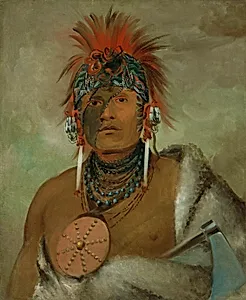
Wá-hón-ga-shee, No Fool, a Great Fop
1832
Medium
Painting
Classification
Painting
Department
Smithsonian Collection
Museum
Smithsonian American Art Museum
Credit
Smithsonian American Art Museum, Gift of Mrs. Joseph Harrison, Jr.
Accession Number
1985.66.24
Rights
Public Domain
Tags
About this artwork
“Meach-o-shin-gaw (the little white bear), Chesh-oo-hong-ha (the man of good sense), and Wa-hon-ga-shee (no fool), are portraits of distinguished Konzas [Kansas/Kaw], and all furnish striking instances of the bold and Roman outline.” (Catlin, Letters and Notes, vol. 2, no. 34, 1841; reprint 1973)
Art Historical Context
In 1832, American artist George Catlin captured dignified profile of Wá-hón-ga-shee, known as "No Fool, a Great Fop," a distinguished member of the Kaw (Konzas) Nation present-day Kansas. This bust-length portrait, painted during Catlin's ambitious travels across the Great Plains, showcases the subject in traditional Indian dress, highlighting his poised expression and elaborate attire—earning him the playful English epithet "Great Fop," suggesting a stylish flair amid his tribal finery. Catlin praised such portraits, including this one alongside those of Meach-o-shin-gaw ("the little white bear") and Chesh-oo-hong-ha ("the man of good sense"), for their "bold and Roman outline," evoking classical sculpture in their strong, noble contours. As a pioneer of ethnographic art, Catlin sought to document Native American cultures before westward expansion altered them forever, creating over 600 portraits that preserve vanishing traditions. Today, housed in the Smithsonian American Art Museum, this work exemplifies Catlin's Romantic commitment to authenticity and humanity, offering visitors a vivid window into Kaw life and the artist's urgent mission to honor Indigenous resilience.
About the Artist
George Catlin · 1796–1872
George Catlin (1796–1872), born in Wilkes-Barre, Pennsylvania, to Putnam Catlin and Polly Sutton—who had been captured by Native Americans during the 1778 Battle of Wyoming—initially pursued a legal career. Trained at Litchfield Law School, he was admitted to the bar in 1819 but abandoned law after two years to study art in Philadelphia in 1823. Self-taught as a portraitist, Catlin quickly gained ...