
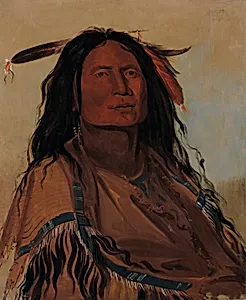
Wúk-mi-ser, Corn, a Miniconjou Warrior
1832
Medium
Painting
Classification
Painting
Department
Smithsonian Collection
Museum
Smithsonian American Art Museum
Credit
Smithsonian American Art Museum, Gift of Mrs. Joseph Harrison, Jr.
Accession Number
1985.66.78
Rights
Public Domain
Tags
About this artwork
“I am now in the heart of the country belonging to the numerous tribe of Sioux or Dahcotas, and have Indian faces and Indian customs in abundance around me. This tribe is one of the most numerous in North America, and also one of the most vigorous and warlike tribes to be found, numbering some forty or fifty thousand, and able undoubtedly to muster, if the tribe could be moved simultaneously, at least eight or ten thousand warriors, well mounted and well armed. This tribe take vast numbers of th...
Art Historical Context
In 1832, American artist George Catlin captured striking portrait *Wúk-mi-ser,, a Miniconjou* at Fort Pierre, in the heart of Sioux—or Dakota—territory. Catlin, a pioneering painter of Native American life, was on a mission to document the customs and visages of Indigenous peoples before Western expansion altered their world forever. This bust-length portrait depicts Wúk-mi-ser, a from the Miniconjou of the Lakota Sioux (also known as Teton Sioux), dressed in traditional regalia that reflects the tribe's proud heritage. Catlin marveled at the Sioux as one of North America's most numerous, vigorous, and warlike tribes, capable of mustering thousands of well-mounted warriors armed with bows, lances, and increasingly guns. Painting amid "Indian faces and customs in abundance," he highlighted their mastery of the plains, taming wild horses near the Rocky Mountains. As a Romantic-era artist, Catlin's realistic oil technique preserved not just a face, but a vanishing way of life, making this work a vital historical record. Today, housed in the Smithsonian American Art Museum, *Wúk-mi-ser* invites us to appreciate the resilience and dignity of the Dakota people through Catlin's empathetic gaze. (198 words)
About the Artist
George Catlin · 1796–1872
George Catlin (1796–1872), born in Wilkes-Barre, Pennsylvania, to Putnam Catlin and Polly Sutton—who had been captured by Native Americans during the 1778 Battle of Wyoming—initially pursued a legal career. Trained at Litchfield Law School, he was admitted to the bar in 1819 but abandoned law after two years to study art in Philadelphia in 1823. Self-taught as a portraitist, Catlin quickly gained ...