
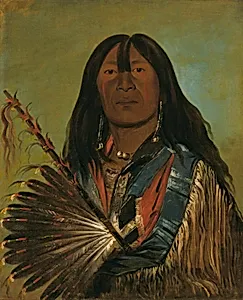
Shón-ka, The Dog, Chief of the Bad Arrow Points Band
1832
Medium
Painting
Classification
Painting
Department
Smithsonian Collection
Museum
Smithsonian American Art Museum
Credit
Smithsonian American Art Museum, Gift of Mrs. Joseph Harrison, Jr.
Accession Number
1985.66.85
Rights
Public Domain
Tags
About this artwork
Little Bear, Steep Wind, and the Dog, who sat for George Catlin during his 1832 Missouri River trip, provided him with a story that dramatized the power of his painterly “medicine.” While Catlin was working on Little Bear’s portrait, a three-quarter view that concealed nearly half his face, the Dog stopped by and observed that Little Bear was “but half a man.” Catlin later described the tragedy sparked by the Dog’s insult: “[Little Bear’s] wife screamed; but it was too late. The gun was in his h...
Art Historical Context
George Catlin's *Shón-ka, The Dog, Chief of the Bad Arrow Band* (1832) captures a prominent Dakota Sioux leader during the artist's ambitious Missouri River expedition. As a pioneering 19th-century painter, Catlin traveled among Native American tribes to document their portraits and customs in oil paintings, creating one of the earliest comprehensive visual records of Indigenous life on the Great Plains before widespread European settlement. This bust-length portrait, showcasing Shón-ka in traditional Indian, exemplifies Catlin's realistic style, blending ethnographic accuracy with dramatic individualism. The artwork is forever linked to a gripping anecdote Catlin recounted from his travels. While painting a three-quarter view portrait of fellow chief Little Bear—which concealed half his face—Shón-ka remarked that the depiction showed Little Bear as "but half a man." The perceived insult ignited a violent clash: Little Bear was shot in the precise half of his face left out of the picture, mangling his jaw, nostril, eye, and exposing his jugular vein. Catlin marveled at this eerie fulfillment of Shón-ka's words, highlighting the mystical power tribes attributed to his "painterly medicine." Housed in the Smithsonian American Art Museum, this painting underscores Catlin's role in preserving vanishing cultures while revealing the tense dynamics between artists and their subjects. It's a vivid window into Sioux leadership and the perilous frontier encounters of 1830s America.
About the Artist
George Catlin · 1796–1872
George Catlin (1796–1872), born in Wilkes-Barre, Pennsylvania, to Putnam Catlin and Polly Sutton—who had been captured by Native Americans during the 1778 Battle of Wyoming—initially pursued a legal career. Trained at Litchfield Law School, he was admitted to the bar in 1819 but abandoned law after two years to study art in Philadelphia in 1823. Self-taught as a portraitist, Catlin quickly gained ...