
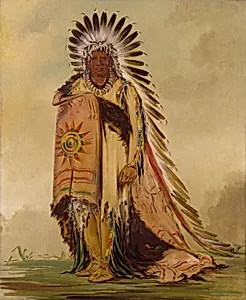
Wán-ee-ton, Chief of the Tribe
1832
Medium
Painting
Classification
Painting
Department
Smithsonian Collection
Museum
Smithsonian American Art Museum
Credit
Smithsonian American Art Museum, Gift of Mrs. Joseph Harrison, Jr.
Accession Number
1985.66.72
Rights
Public Domain
Tags
About this artwork
In 1830, Catlin accompanied William Clark, of the celebrated Lewis and Clark expedition, up the Mississippi River from St. Louis to Fort Crawford. Two years later, he began the first of several journeys deep into the frontier, traveling up the Missouri River. At Fort Pierre, a fur-trading post situated in what is now South Dakota, he met Wán-ee-ton, chief of the Yanktonai Nakota tribe. Catlin considered him “one of the most noted and dignified, as well graceful chiefs of the Sioux tribe,” and we...
Art Historical Context
In 1832, George Catlin, a pioneering American artist dedicated to documenting Native American life, painted this striking full-length portrait of Wán-ee-ton, chief of the Yanktonai Nakota tribe (part of the Sioux or Dakota peoples). Catlin encountered the chief at Fort Pierre, a remote fur-trading post in present-day South Dakota, during one of his daring expeditions up the Missouri River. Having traveled from St. Louis two years earlier with William Clark of the Lewis and Clark fame, Catlin sought to capture the dignity and traditions of indigenous leaders before rapid westward expansion altered their world forever. Catlin praised Wán-ee-ton as "one of the most noted and dignified, as well graceful chiefs of the Sioux tribe." The portrait depicts him in splendid regalia: a head-dress of war-eagle’s quills and ermine, paired with a painted robe that symbolizes his status and warrior heritage. Rendered in oil, Catlin's realistic style emphasizes ethnographic detail, blending portraiture with cultural anthropology to create vivid records of a vanishing era. This work, now in the Smithsonian American Art Museum, exemplifies Catlin's lifelong mission—over 600 portraits forming his "Indian Gallery." It offers visitors a poignant window into 19th-century Plains Indian life, highlighting themes of leadership, pride, and resilience amid encroaching change.
About the Artist
George Catlin · 1796–1872
George Catlin (1796–1872), born in Wilkes-Barre, Pennsylvania, to Putnam Catlin and Polly Sutton—who had been captured by Native Americans during the 1778 Battle of Wyoming—initially pursued a legal career. Trained at Litchfield Law School, he was admitted to the bar in 1819 but abandoned law after two years to study art in Philadelphia in 1823. Self-taught as a portraitist, Catlin quickly gained ...