
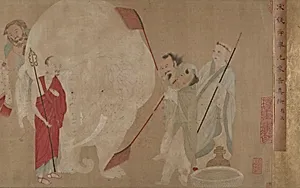
明/清 佚名 錢選(僞款) 洗象圖 卷|Washing the Sacred Elephant
Medium
Handscroll; ink and color on silk
Dimensions
13 3/8 x 22 1/2 in. (34.0 x 57.2 cm)
Classification
Paintings
Culture & Period
China · Ming (1368–1644) or Qing dynasty (1644–1911)
Department
Asian Art
Museum
Metropolitan Museum of Art, New York, NY
Credit
From the Collection of A. W. Bahr, Purchase, Fletcher Fund, 1947
Accession Number
47.18.96
Rights
Public Domain
Tags
Art Historical Context
This delicate handscroll, *Washing the Sacred Elephant dates to China's Ming (1368–4) or Qing (1644–1911) and bears a pseudo-signature of the Yuan master Qian Xuan (12351290), suggesting an unidentified artist emulating his refined, archaistic style. Crafted in ink and color on silk—a luxurious medium prized for its luminous sheen and ability to capture subtle gradations—the painting measures just 13⅜ × 22½ inches, ideal for intimate, sequential viewing as the scroll unrolls. Acquired in 1947 through the Fletcher Fund from collector A. W. Bahr, it now graces the Metropolitan Museum of Art's Asian Art collection. The scene vividly portrays men tending to a majestic elephant in a serene riverside setting, a rare motif in Chinese painting that evokes Buddhist symbolism. Elephants, often linked to sacred narratives like the Buddha's birth, represent purity, strength, and enlightenment here, with attendants bathing the beast in a ritualistic act of reverence. This composition draws on Qian Xuan's legacy of orthodox Song-dynasty influences, blending meticulous ink lines for figures and animals with soft color washes to convey texture and atmosphere. As a handscroll, it invites viewers into a meditative journey, highlighting the enduring cultural fascination with harmony between humans and nature in imperial China. A charming window into elite connoisseurship, it reminds us how later artists honored their forebears through skillful imitation.