
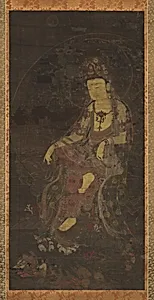
수월관음도 고려|水月觀音圖 高麗|Water-moon Avalokiteshvara
first half of the 14th century
Medium
Hanging scroll; ink and color on silk
Dimensions
Image: 45 1/16 × 21 7/8 in. (114.5 × 55.6 cm) Overall with mounting: 79 3/8 × 28 in. (201.6 × 71.1 cm) Overall with knobs: 79 3/8 × 30 1/8 in. (201.6 × 76.5 cm)
Classification
Paintings
Culture & Period
Korea · Goryeo dynasty (918–1392)
Department
Asian Art
Museum
Metropolitan Museum of Art, New York, NY
Credit
Charles Stewart Smith Collection, Gift of Mrs. Charles Stewart Smith, Charles Stewart Smith Jr., and Howard Caswell Smith, in memory of Charles Stewart Smith, 1914
Accession Number
14.76.6
Rights
Public Domain
Tags
Art Historical Context
This exquisite hanging scroll, *Water-Moon Avalokitesh*, hails from the Goryeo dynasty (918–139), a golden age of Korean Buddhism when such devotional images flourished. Created by an unidentified artist in the half of the 14 century, it portrays Avalokiteshvara, the compassionate Bodhisattva who embodies mercy and hears the world's cries for help. The "water-moon" motif—typically showing the figure poised gracefully on a rocky outcrop amid misty waters—evokes serenity and the illusory nature of existence, inviting contemplation. Painted in ink and color on silk, a luxurious medium reserved for elite patrons and temple treasures, the work exemplifies Goryeo's mastery of refined brushwork and vibrant mineral pigments. These scrolls were unrolled for meditation or rituals, their delicate silk surfaces shimmering under candlelight. At nearly 80 inches tall when fully mounted, it commands a sense of sacred presence, blending naturalism in flowing robes and rocky forms with ethereal spirituality. A gift to the Metropolitan Museum of Art in 1914 from the Charles Stewart Smith Collection, this painting highlights Goryeo Korea's pivotal role in East Asian Buddhist art, bridging Chinese influences with uniquely Korean elegance. Visitors will appreciate its timeless call to compassion amid life's tempests.