
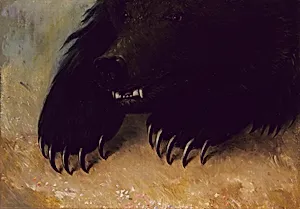
Weapons and Physiognomy of the Grizzly Bear
1846-1848
Medium
Painting
Classification
Painting
Department
Smithsonian Collection
Museum
Smithsonian American Art Museum
Credit
Smithsonian American Art Museum, Gift of Mrs. Joseph Harrison, Jr.
Accession Number
1985.66.563B
Rights
Public Domain
Tags
About this artwork
The prairies of the 1830s were a paradise for animal predators as well as enthusiastic huntsmen. Eagles, wolves, mountain lions, and grizzly bears were among the beasts hunting the abundant antelope, elk, and buffalo. George Catlin described many encounters between predators and prey, but could only make quick sketches of these incidents as they unfolded, in hopes of capturing the excitement in more finished studio works. Catlin disapproved of white settlers’ encroaching on Indian lands, yet he ...
Art Historical Context
George Catlin, the pioneering 19th-century artist known for his vivid depictions of Native American life and the untamed American West, created *Weapons and Physiognomy of the Grizzly Bear* between 1846 and 1848. A master of Romantic realism, Catlin traveled the Great Plains in the 1830s, sketching wildlife and dramatic encounters amid vast herds of antelope, elk, and buffalo. This oil painting, now in the Smithsonian American Art Museum, captures the grizzly's formidable claws, teeth—"weapons"—and expressive facial features, or physiognomy, transforming quick field sketches into a powerful studio work. In the 1830s prairies, a predator's paradise teeming with eagles, wolves, mountain lions, and grizzlies, Catlin witnessed thrilling hunts but often could only jot hasty notes for later refinement. His art bridged worlds: while he decried white settlers' encroachment on Indigenous lands, these scenes enticed Euro-American sportsmen westward, romanticizing the frontier's raw excitement. This painting exemplifies Catlin's technique of blending scientific observation with dramatic flair, highlighting the grizzly as a symbol of wilderness might. Today, it reminds us of a vanishing era, preserving the awe of America's wild heart before expansion forever altered it. (198 words)
About the Artist
George Catlin · 1796–1872
George Catlin (1796–1872), born in Wilkes-Barre, Pennsylvania, to Putnam Catlin and Polly Sutton—who had been captured by Native Americans during the 1778 Battle of Wyoming—initially pursued a legal career. Trained at Litchfield Law School, he was admitted to the bar in 1819 but abandoned law after two years to study art in Philadelphia in 1823. Self-taught as a portraitist, Catlin quickly gained ...