
Weapons and Physiognomy of the Grizzly Bear
1846-1848
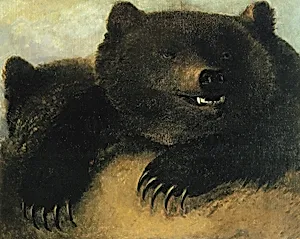
Medium
Painting
Classification
Painting
Department
Smithsonian Collection
Museum
Smithsonian American Art Museum
Credit
Smithsonian American Art Museum, Gift of Mrs. Joseph Harrison, Jr.
Accession Number
1985.66.563
Rights
Public Domain
Tags
About this artwork
The prairies of the 1830s were a paradise for animal predators as well as enthusiastic huntsmen. Eagles, wolves, mountain lions, and grizzly bears were among the beasts hunting the abundant antelope, elk, and buffalo. George Catlin described many encounters between predators and prey, but could only make quick sketches of these incidents as they unfolded, in hopes of capturing the excitement in more finished studio works. Catlin disapproved of white settlers’ encroaching on Indian lands, yet he ...
Art Historical Context
George Catlin's *Weapons and Physiognomy the Grizzly Bear*1846-1848) captures the raw power of one of North America's most formidable predators. Painted during Catlin's later career, this work highlights the grizzly's formidable claws, teeth, and expressive—its "weapons and physiogn"—as symbols of the untamed wilderness. Catlin, a pioneering 19th-century artist known for his vivid depictions of Native American life the American West, drew from his extensive travels across the prairies in the1830s, where grizzlies roamed alongside wolves, eagles, and mountain lions, preying on abundant buffalo, elk, and antelope. The painting reflects Catlin's on-the-spot sketching technique amid thrilling predator-prey encounters, which he later refined into detailed studio pieces. This approach allowed him to convey the excitement of the frontier hunt, appealing to Euro-American sportsmen eager for adventure. Yet, Catlin's work carries deeper irony: while he lamented white settlers' encroachment on Indigenous lands, his dramatic scenes enticed eastward audiences westward, romanticizing a disappearing wild paradise. Housed in the Smithsonian American Art Museum, this oil painting (gift of Mrs. Joseph Harrison, Jr.) endures as a window into the ecological richness of pre-industrial America, blending natural history with cultural commentary on expansion and exploitation.
About the Artist
George Catlin · 1796–1872
George Catlin (1796–1872), born in Wilkes-Barre, Pennsylvania, to Putnam Catlin and Polly Sutton—who had been captured by Native Americans during the 1778 Battle of Wyoming—initially pursued a legal career. Trained at Litchfield Law School, he was admitted to the bar in 1819 but abandoned law after two years to study art in Philadelphia in 1823. Self-taught as a portraitist, Catlin quickly gained ...