
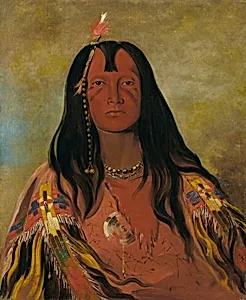
H'co-a-h'co-a-h'cotes-min, No Horns on His Head, a Brave
1832
Medium
Painting
Classification
Painting
Department
Smithsonian Collection
Museum
Smithsonian American Art Museum
Credit
Smithsonian American Art Museum, Gift of Mrs. Joseph Harrison, Jr.
Accession Number
1985.66.146
Rights
Public Domain
Tags
About this artwork
George Catlin painted this portrait of No Horns on His Head and Rabbit’s Skin Leggings (see 1985.66.145), both Nez Perce braves, as a pair and described his subjects in these words: “These two men, when I painted them, were in beautiful Sioux dresses . . . [they] were part of a delegation that came across the Rocky Mountains to St. Louis . . .” Catlin noted that he had traveled two thousand miles with these braves “towards their own country,” and during that time had become “much pleased with th...
Art Historical Context
In 1832, George Catlin captured this striking bust portrait of H'co-a-h'co-a-h'cotes-min, known as No Horns on His Head, a brave of the Nez Perce tribe. Catlin, a pioneering American artist dedicated to documenting Native American life, painted this work alongside a companion portrait of Rabbit’s Skin Leggings. Both men wore elaborate Sioux dresses, blending tribal styles in a vivid display of Plains Indian regalia that highlights the cultural exchanges of the era. The portrait stems from a remarkable encounter: No Horns on His Head was part of a Nez Perce delegation that journeyed across the Rocky Mountains to St. Louis. Catlin accompanied them for 2,000 miles toward their homeland, developing deep admiration for their "manners and dispositions," as he wrote in his *Letters and Notes* (1841). This journey underscores the artwork's historical significance, offering a rare glimpse into early 19th-century intertribal diplomacy and the fading traditional lifeways amid westward expansion. Catlin's realistic style, rooted in Romanticism, emphasized authentic representation over idealization, making this painting a vital record in the Smithsonian American Art Museum's collection. It invites visitors to appreciate the dignity and resilience of Nez Perce warriors through one artist's empathetic lens.
About the Artist
George Catlin · 1796–1872
George Catlin (1796–1872), born in Wilkes-Barre, Pennsylvania, to Putnam Catlin and Polly Sutton—who had been captured by Native Americans during the 1778 Battle of Wyoming—initially pursued a legal career. Trained at Litchfield Law School, he was admitted to the bar in 1819 but abandoned law after two years to study art in Philadelphia in 1823. Self-taught as a portraitist, Catlin quickly gained ...