
Woede
Medium
engraving
Dimensions
102; 62
Rights
Public Domain
About this artwork
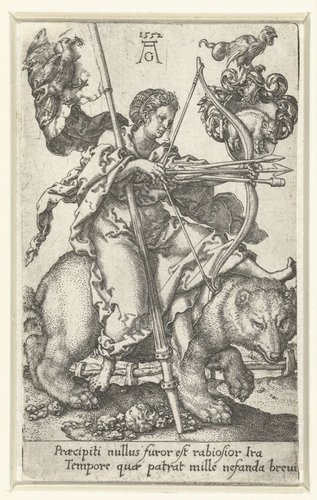
Personificatie van Woede. Vrouw rijdend op een beer, een boog met drie pijlen gespannen, en een vaandel met daarop een afbeelding van een vogel met een vlieg. Rechtsboven een wapenschild met een zwijn, daarboven een kip met een slangestaart. Onder de voorstelling een tweeregelige tekst in het Latijn. Derde prent uit een serie van zeven.
Art Historical Context
**Woede (Wrath)**, an engraving by Heinrich Aldegrever from 1552, captures the fiery essence of one of the Seven Deadly Sins. Aldegrever, a leading figure among the German "Little Masters" of the Northern Renaissance, specialized in these diminutive yet intricate prints—here just 102 × 62 mm—allowing wide dissemination of moral allegories during the Reformation era. As the third in a series of seven, it reflects the period's obsession with vice and virtue, drawing viewers into a vivid personification of uncontrolled anger. At the center rides a fierce woman on a bear, symbolizing brute rage, as she draws a bow with three arrows poised for vengeance. Her banner bears a bird clutching a fly, evoking proverbs of petty irritation escalating to fury, while an upper-right shield displays a boar—perhaps heraldic or emblematic of wild temper—and a monstrous hen with a snake's tail hints at deceptive malice. Below, a two-line Latin inscription likely delivers a cautionary moral, urging restraint in a turbulent 16th-century world of religious strife. Aldegrever's masterful engraving technique shines in the fine lines and textures, from the bear's shaggy fur to the chimeric details, making complex symbolism accessible on silver or paper. These prints weren't just art but tools for ethical reflection, bridging elite patronage and popular devotion in Renaissance Europe.
About the Artist
Heinrich Aldegrever · 1502–1561
Heinrich Aldegrever, born in 1502 in Paderborn, Westphalia, to parents Herman and Katherine Trippenmeker—a family of clog-makers known by the dialect name Trippenmecker—emerged as a multifaceted artist in the German Renaissance. His early training remains undocumented, though he likely apprenticed in a Soest goldsmith's workshop after relocating there around 1525, where he joined the painters' gui...