
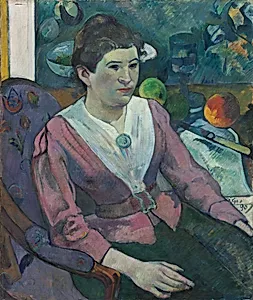
Woman in Front of a Still Life by Cezanne
1890
Medium
Oil on linen canvas
Dimensions
65.3 × 54.9 cm (25 11/16 × 21 5/8 in.); Framed: 82.9 × 73.4 × 10.5 cm (32 5/8 × 28 7/8 × 4 1/8 in.)
Classification
painting
Department
Painting and Sculpture of Europe
Museum
Art Institute of Chicago
Accession Number
16648
Rights
Public Domain
About this artwork
The seated woman here remains unidentified, but the still-life painting dominating the background is well known: Paul Cezanne’s Still Life with Fruit Dish (1879–80; Museum of Modern Art, New York). Gauguin’s version is nearly the same scale as the original. In certain aspects of the compo-sition, Gauguin emulated Cezanne’s style, like the way he flattened the picture plane so that the woman appears to tip forward out of her chair. Before becoming an artist, Gauguin was an art collector. Cezanne...
Art Historical Context
Paul Gauguin’s *Woman in Front of a Still Life by Cézanne* (1890) captures a quiet moment of artistic admiration. Painted in oil on linen canvas, the work places a seated woman before a still life by Paul Cézanne, Gauguin’s contemporary and occasional correspondent. At roughly 65 by 55 centimeters, the intimate scale invites close viewing, allowing visitors to appreciate the subtle dialogue between two Post-Impressionist masters. By 1890 Gauguin was already moving away from Impressionism toward the bolder colors and simplified forms of Synthetism. Including a Cézanne still life within his own composition underscores the respect he felt for Cézanne’s structural approach to form and color. The painting thus serves as both portrait and tribute, linking two artists whose innovations would shape twentieth-century art. Today the canvas resides in the Art Institute of Chicago’s European Painting and Sculpture collection, where it offers viewers a glimpse of the creative exchanges that defined the late nineteenth century.
About the Artist
Paul Gauguin · 1848–1903
Paul Gauguin (1848-1903) was a French Post-Impressionist painter whose bold experiments with color, form, and subject matter made him one of the most influential figures in the transition from 19th-century art to modernism. His rejection of European civilization for the perceived authenticity of 'primitive' cultures established an archetype of artistic exile that continues to resonate. Gauguin's ...