
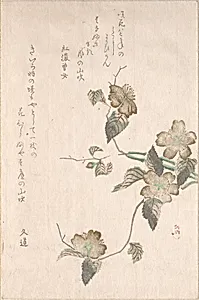
Yamabuki Flowers (kerria japonica)
18th–19th century
Medium
Woodblock print (surimono); ink and color on paper
Dimensions
8 5/16 x 5 1/2 in. (21.1 x 14 cm)
Classification
Prints
Culture & Period
Japan · Edo period (1615–1868)
Department
Asian Art
Museum
Metropolitan Museum of Art, New York, NY
Credit
H. O. Havemeyer Collection, Bequest of Mrs. H. O. Havemeyer, 1929
Accession Number
JP2203
Rights
Public Domain
Tags
Art Historical Context
This exquisite woodblock print, *Yamabuki Flowers (kerria japonica)*, captures the vibrant yellow blooms and lush green leaves of the yamabuki shrub, a beloved symbol of spring in Japanese culture. Created by an unidentified artist during Japan's Edo period (1615–1868), this intimate surimono— a luxurious, privately commissioned print often exchanged as a New Year's greeting or poetic announcement—showcases the refined artistry of the era. Measuring just 8 5/16 x 5 1/2 inches, its compact size invites close contemplation, with ink and color on paper rendered through precise woodblock techniques for luminous depth and texture. Surimono prints like this one elevated woodblock printing beyond mass-produced ukiyo-e, employing high-quality papers, subtle embossing, and metallic pigments to evoke seasonal beauty and literary elegance. Yamabuki flowers, frequently celebrated in classical poetry for their golden resilience amid mountain streams, reflect Edo Japan's deep reverence for nature's fleeting cycles, blending aesthetic pleasure (miyabi) with subtle impermanence (mono no aware). Part of the Metropolitan Museum of Art's Asian Art collection, it entered via the renowned H. O. Havemeyer bequest in 1929, preserving a window into 18th–19th-century private artistry.