
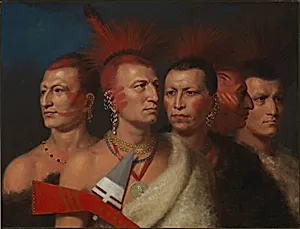
Young Omahaw, War Eagle, Little Missouri, and Pawnees
Medium
Painting
Classification
Painting
Department
Smithsonian Collection
Museum
Smithsonian American Art Museum
Credit
Smithsonian American Art Museum, Gift of Miss Helen Barlow
Accession Number
1985.66.384,222
Rights
Public Domain
Tags
About this artwork
These Plains Indian chiefs were among many who traveled to Washington to meet with the president to negotiate their territorial rights with the government. At the White House, the Capitol, and in private homes, policymakers employed bribery, dazzle, and intimidation to win the cooperation of these men. In his Seventh Street studio, Charles Bird King painted their portraits, creating a gallery of allies in the government’s plan to settle the Indian question peacefully.
Art Historical Context
In 1821, Charles Bird King painted this striking group portrait of four Plains Indian leaders—Young Omahaw, War Eagle, Little Missouri, and Pawnees—who had journeyed to Washington, D.C., to negotiate territorial rights with the U.S. government. These diplomatic visits were part of early federal efforts to address what policymakers called the “Indian question” through treaties and alliances. King captured the men in his Seventh Street studio, creating dignified likenesses that reflected both their status as tribal representatives and the tense political climate surrounding westward expansion. The painting belongs to a larger series of Native American portraits commissioned during this era, many of which now reside in the Smithsonian American Art Museum. Rendered in oil on canvas, King’s work combines formal European portrait traditions with careful attention to the sitters’ distinctive clothing, accessories, and bearing. A spear visible in the composition hints at symbols of leadership and protection, while the bust-like framing emphasizes the chiefs’ individual presence. Today the work offers visitors a window into a pivotal moment of cross-cultural exchange, reminding us of the complex negotiations that shaped early American history.