Ctrl K
Before Dürer, artists were craftsmen. After him, they were geniuses. This exhibition traces one man's audacious journey from a Nuremberg goldsmith's workshop to the courts of emperors — and into the mirror, where he painted himself as Christ.
22 works · 3 museums
In 1500, a 28-year-old German artist did something no European painter had ever dared. He painted himself facing the viewer head-on, perfectly symmetrical, right hand raised in what could only be a blessing — the pose reserved exclusively for images of Christ. His monogram, the famous "AD," floated beside the inscription: "I, Albrecht Dürer of Nuremberg, painted myself in everlasting colors at the age of twenty-eight years."
Everlasting. He was not hoping. He was announcing.
That self-portrait, now in Munich's Alte Pinakothek, does not appear in this exhibition. But its spirit haunts every work here. Because Dürer was not simply a great artist — he was the first artist to understand that being an artist meant something. That the person holding the brush mattered as much as the painting on the wall.
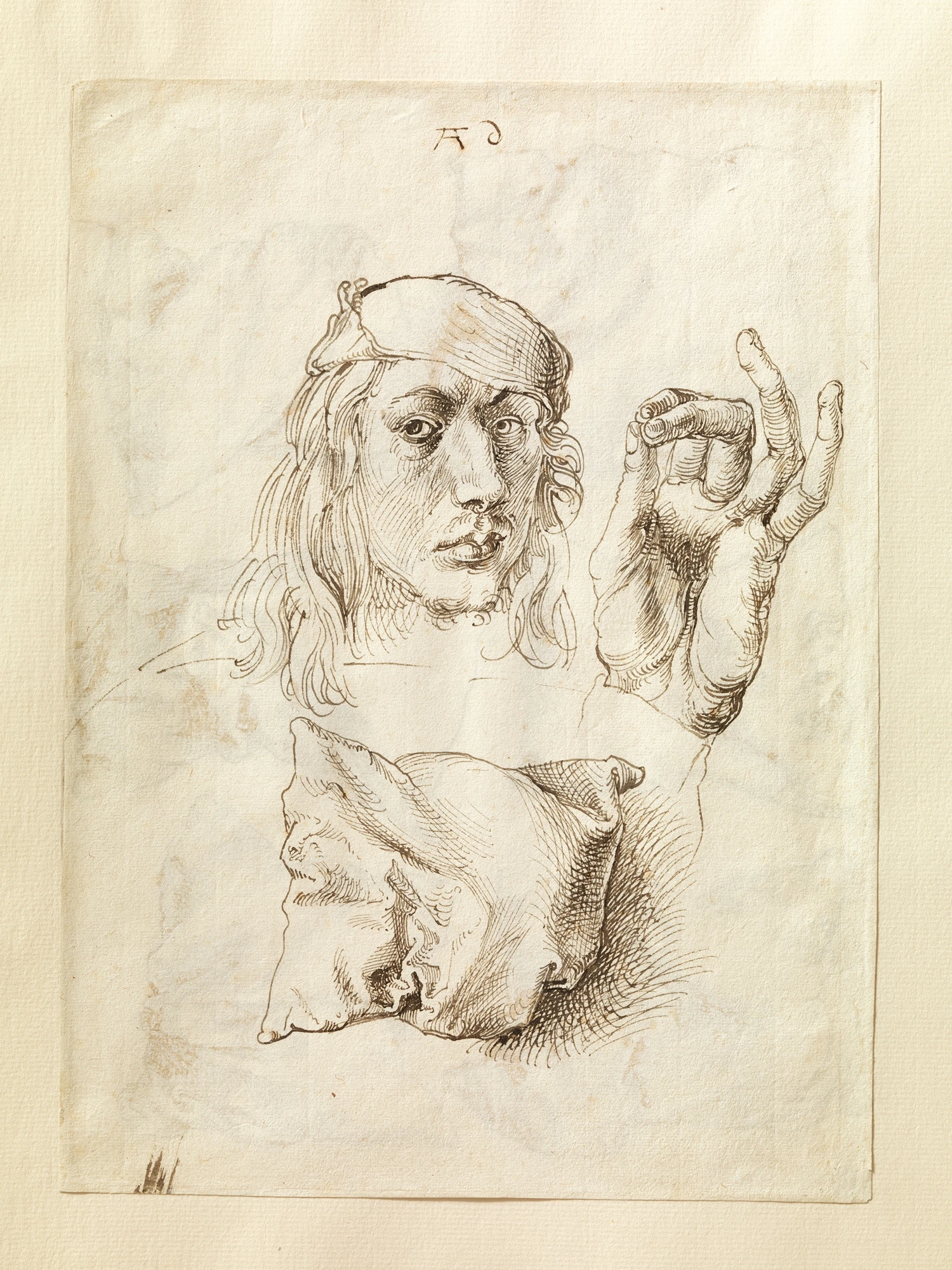
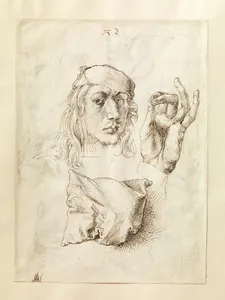
Albrecht Dürer was born in 1471, the third of eighteen children. His father was a Hungarian goldsmith who had emigrated to Nuremberg, and the boy learned to engrave metal before he learned to draw on paper. Look at the earliest work in this exhibition — the Self-Portrait with Hand and Pillow Studies from 1493, when Dürer was twenty-two. It is a page of practice: a face, a hand, six pillows rendered with obsessive precision. But notice the face. He is staring at himself with the intensity of a man who already knows he is somebody.
His father wanted him to be a goldsmith. Dürer wanted something larger. He apprenticed instead under Michael Wolgemut, Nuremberg's leading painter, then set off on a Wanderjahre — the traditional journeyman's trip — that would take him through the Rhineland and, fatefully, to Italy.
Nothing in Northern Europe prepared Dürer for what he found in Venice. The Italians painted bodies — muscular, proportioned, alive with classical geometry. Dürer's northern tradition painted surfaces — fur, lace, jewels, the exact curl of a strand of hair. In Venice, he discovered that you could do both.
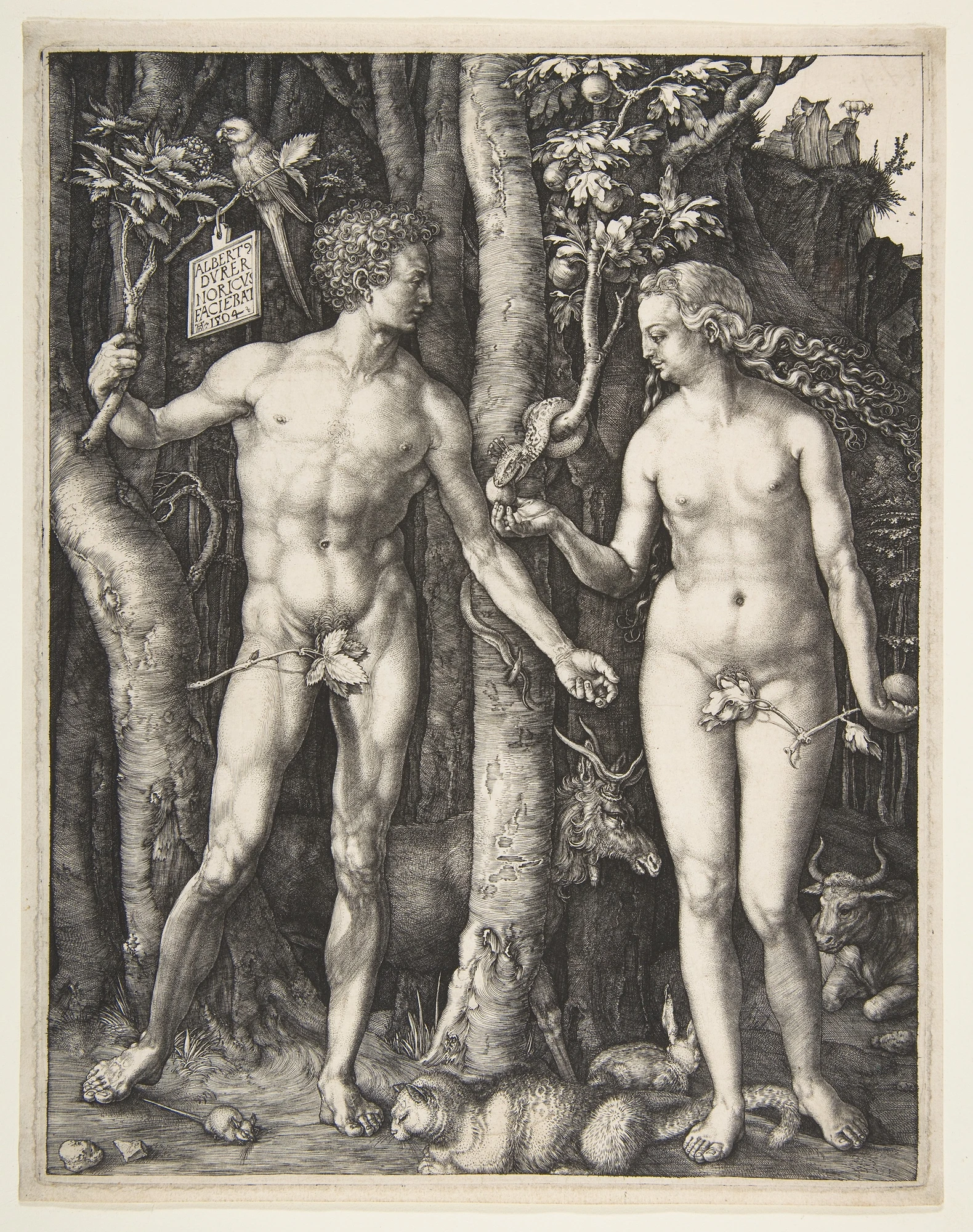
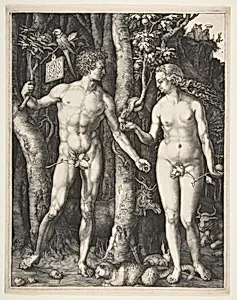
The Adam and Eve engraving of 1504 is the manifesto of this synthesis. Every inch is impossibly detailed in the Northern manner — look at the bark, the leaves, the cat and mouse at Adam's feet (symbolizing the temperaments about to be unleashed by the Fall). But the bodies themselves are pure Italian: idealized, classical, proportioned according to mathematical ratios Dürer had spent years calculating. Four animals hide in the background — elk, rabbit, cat, ox — representing the four humors that will corrupt humanity after the fruit is bitten. It is a theological diagram disguised as a nude.
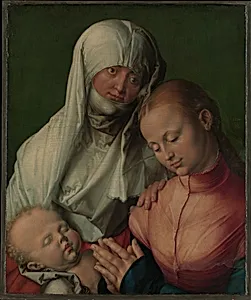
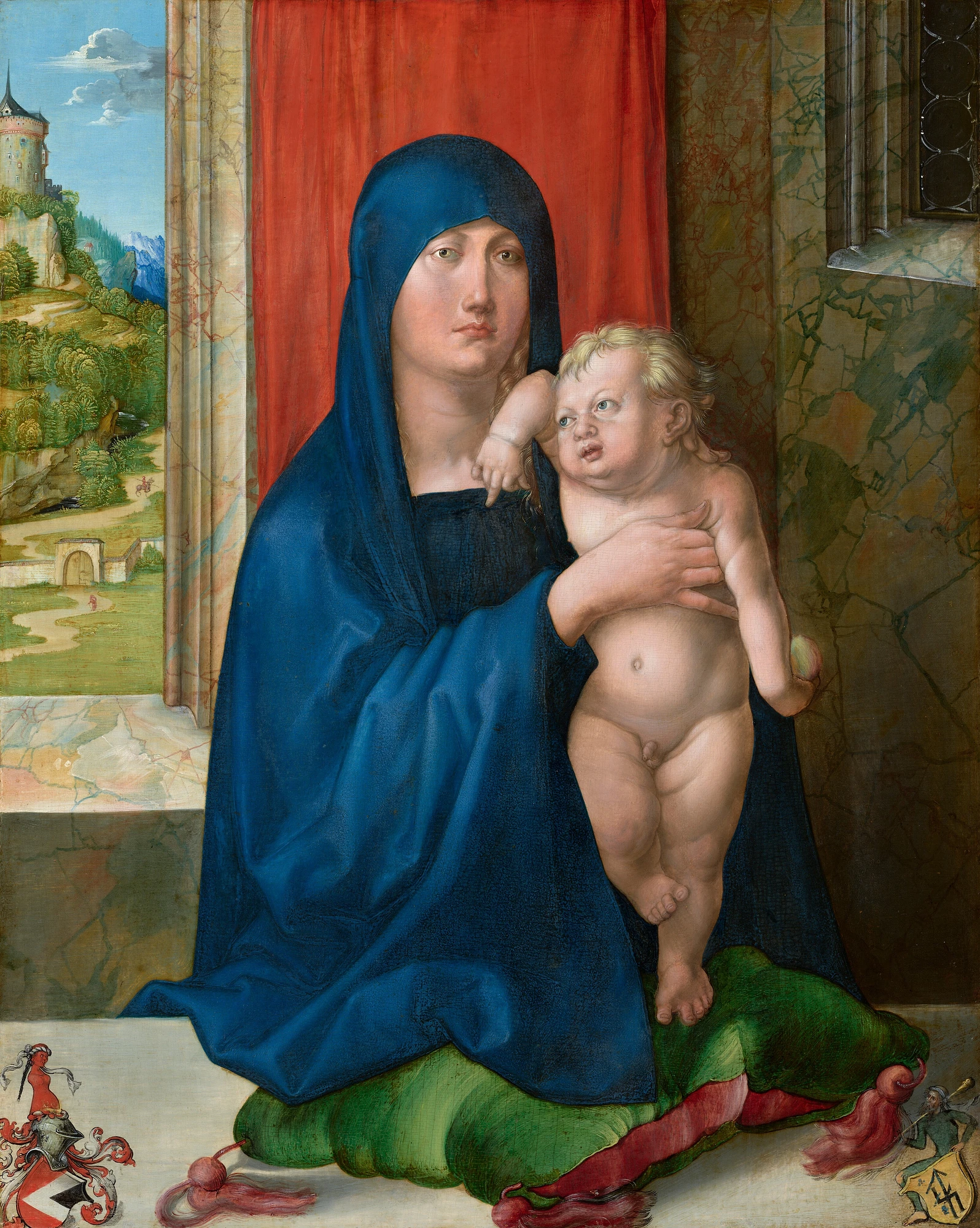
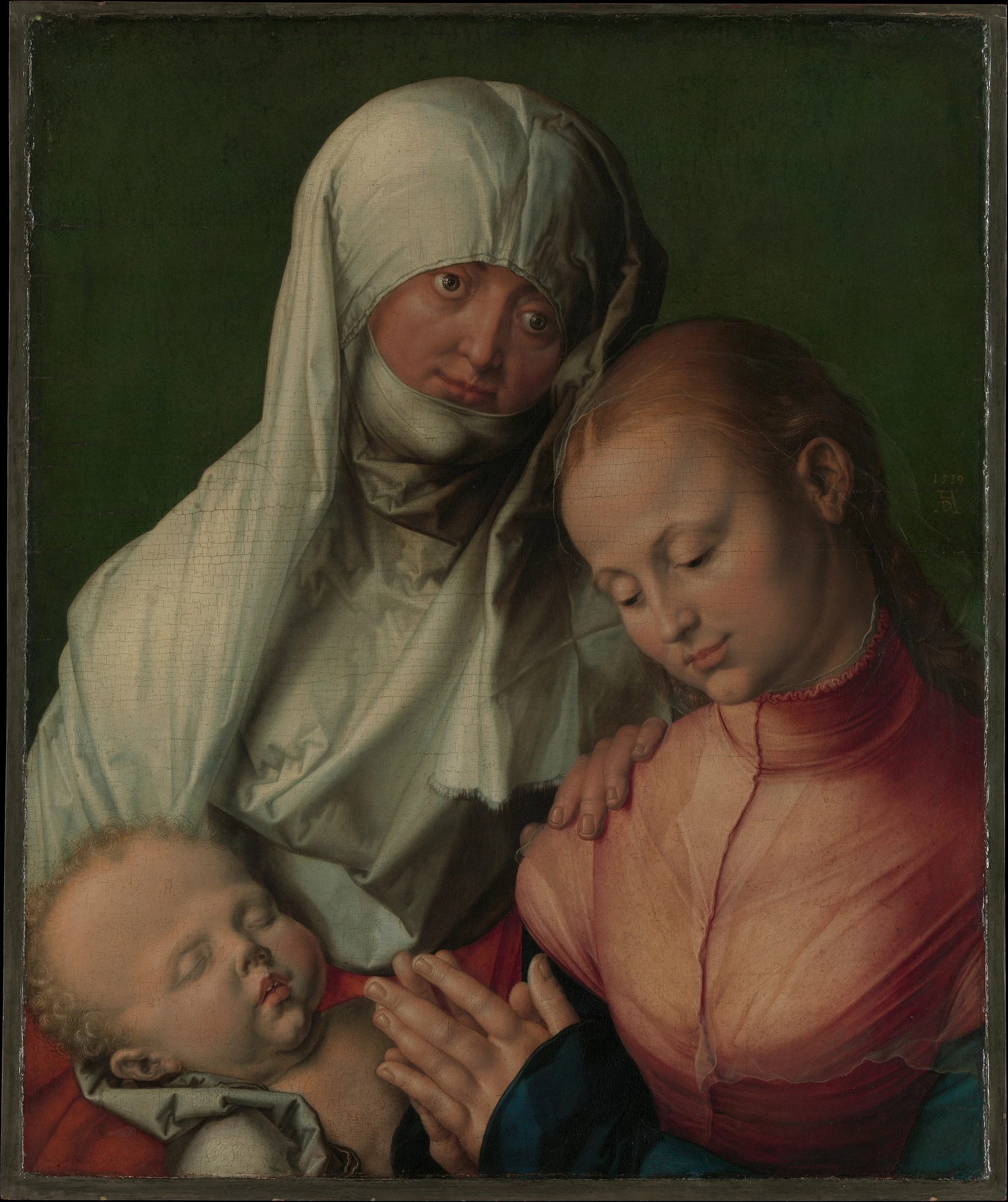
Around the same time, he painted the Madonna and Child at the National Gallery — an oil panel whose reverse conceals Lot and His Daughters, a subject of drunkenness and incest painted with the same tender technique as the Virgin on the other side. Dürer understood that the sacred and the profane shared the same skin.
![Lot and His Daughters [reverse] | c. 1496/1499 · Oil on panel | National Gallery of Art](https://images.artheonmuseum.org/nga/full/lot-and-his-daughters-reverse-nga-41599.webp)
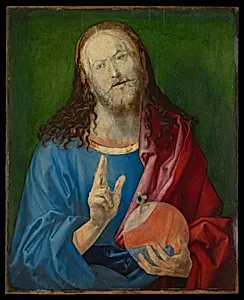
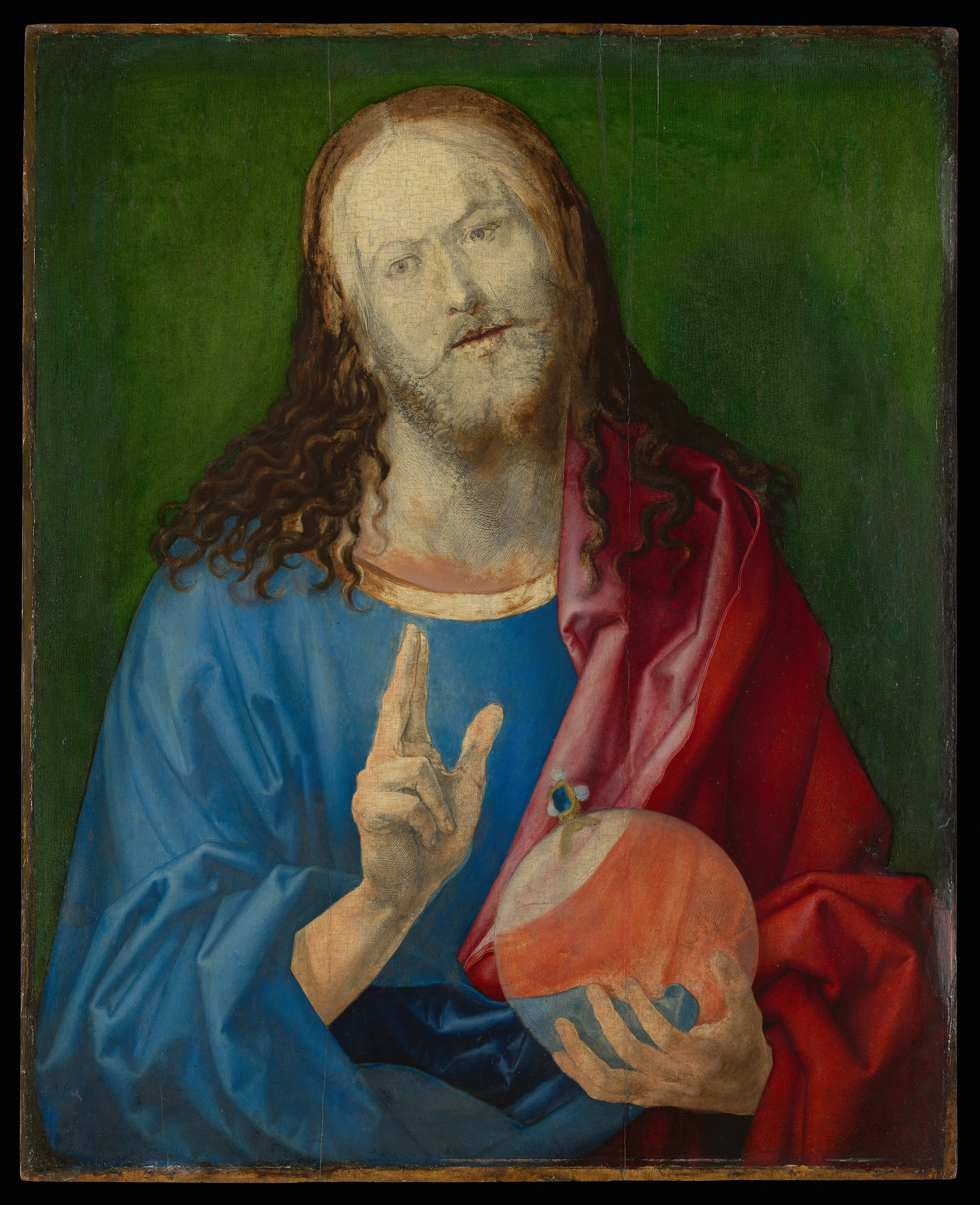
The Salvator Mundi — Christ as Savior of the World — dates from roughly 1505. It is small, intimate, and unmistakably self-referential. The face of Christ carries Dürer's own features. He was not being blasphemous. He was being logical: if God created man in His image, then the artist who creates images participates in the divine act. The brush is a form of prayer.
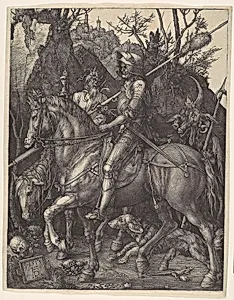
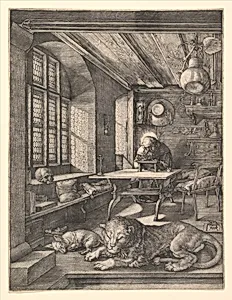
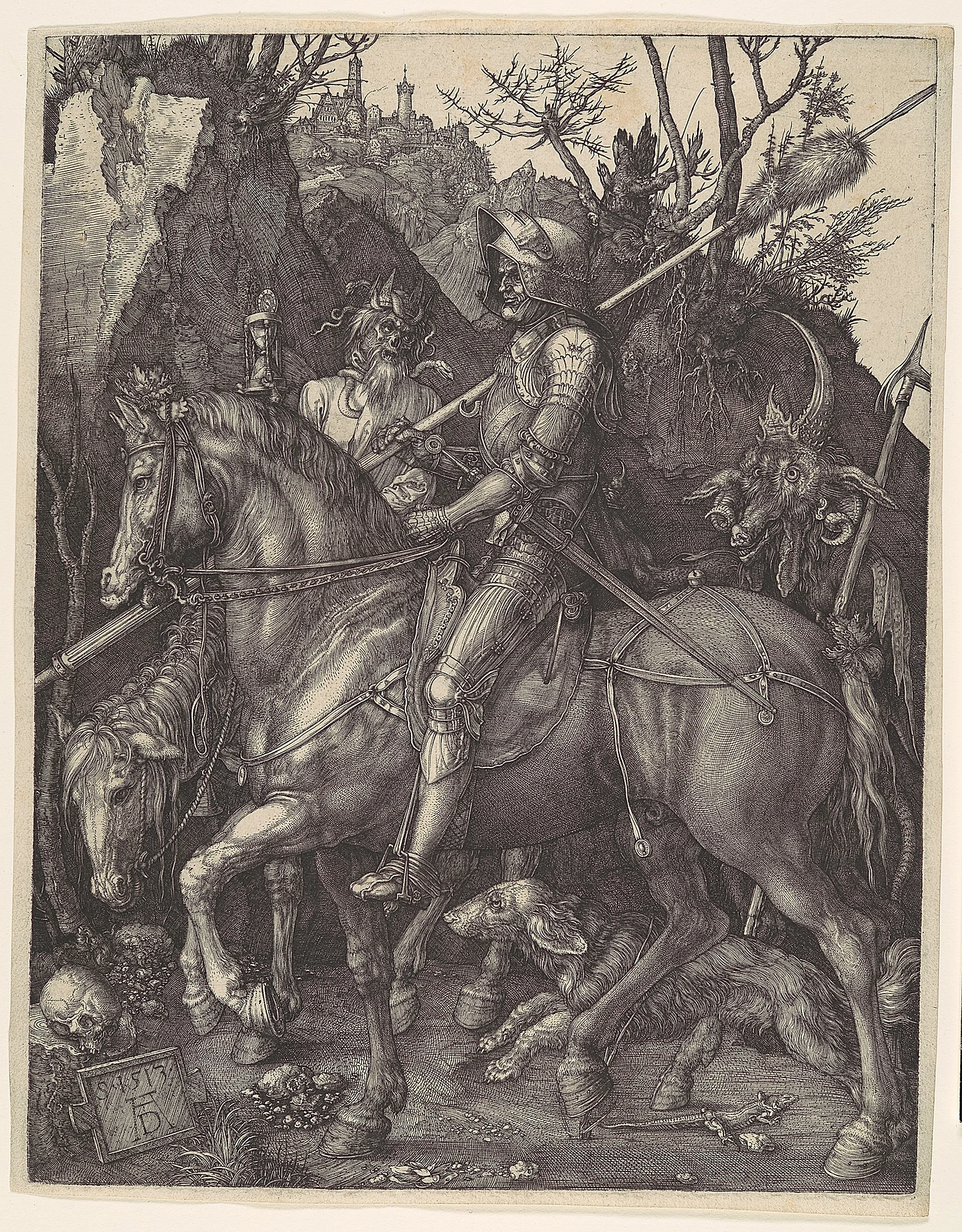
In a single explosive year, Dürer produced three engravings so technically perfect and intellectually dense that art historians simply call them the Meisterstiche — the Master Prints. They have been analyzed for five centuries and are still not fully understood.
Knight, Death, and the Devil (1513) shows an armored rider moving steadily forward through a dark valley. Death holds an hourglass beside him; the Devil lurks behind, grotesque and pig-snouted. The knight does not look at either. His horse walks on. The message seems clear — Christian fortitude in the face of mortality — but the knight's expression is not serene. It is blank. He is not brave; he is beyond fear. That is more unsettling than courage.
Saint Jerome in His Study (1514) is the opposite world: warm, domestic, flooded with light. A scholar works at his desk while a lion sleeps on the floor beside a small dog. Every object — the gourd hanging from the ceiling, the skull on the windowsill, the hourglass above — carries symbolic weight. But the overwhelming impression is of peace. This is what the knight is riding toward.

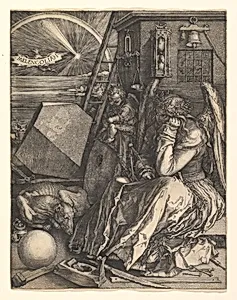
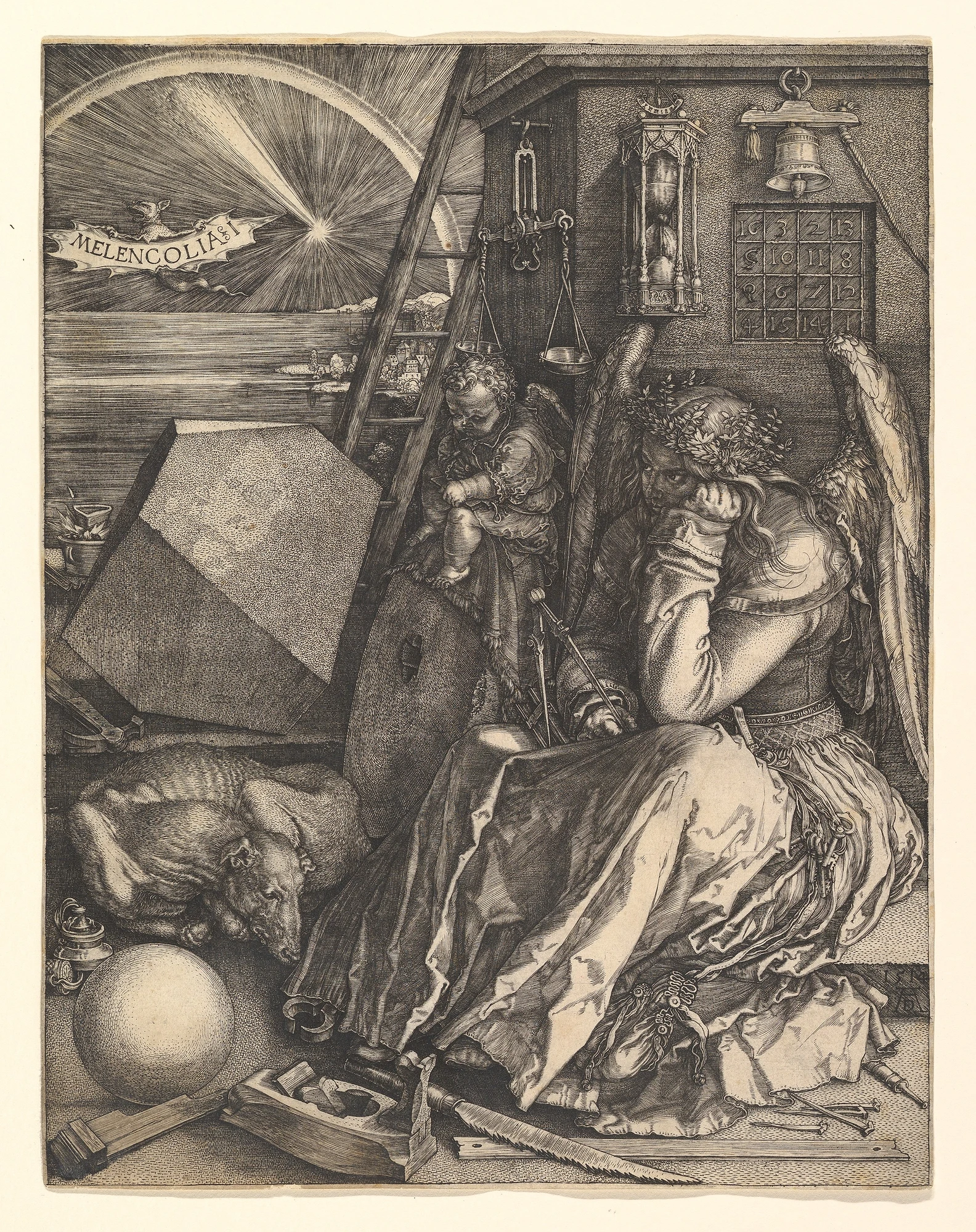
Melencolia I is the enigma. A winged figure sits surrounded by the tools of every intellectual discipline — geometry, carpentry, alchemy, astronomy. A magic square on the wall. A sleeping dog. A brooding bat overhead. The figure does nothing. She holds a compass but does not measure. She stares into space with an expression of profound, intelligent despair.
This is the patron saint of everyone who has ever known too much to act.
The Roman numeral "I" in the title implies there were meant to be others — Melencolia II, III. Dürer never made them. Perhaps he understood that this single image said everything about the paralysis of the brilliant mind.
Dürer did not divide art from science. For him, they were the same discipline approached from different angles.
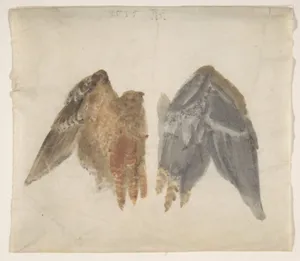
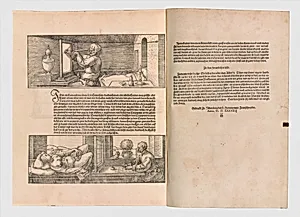
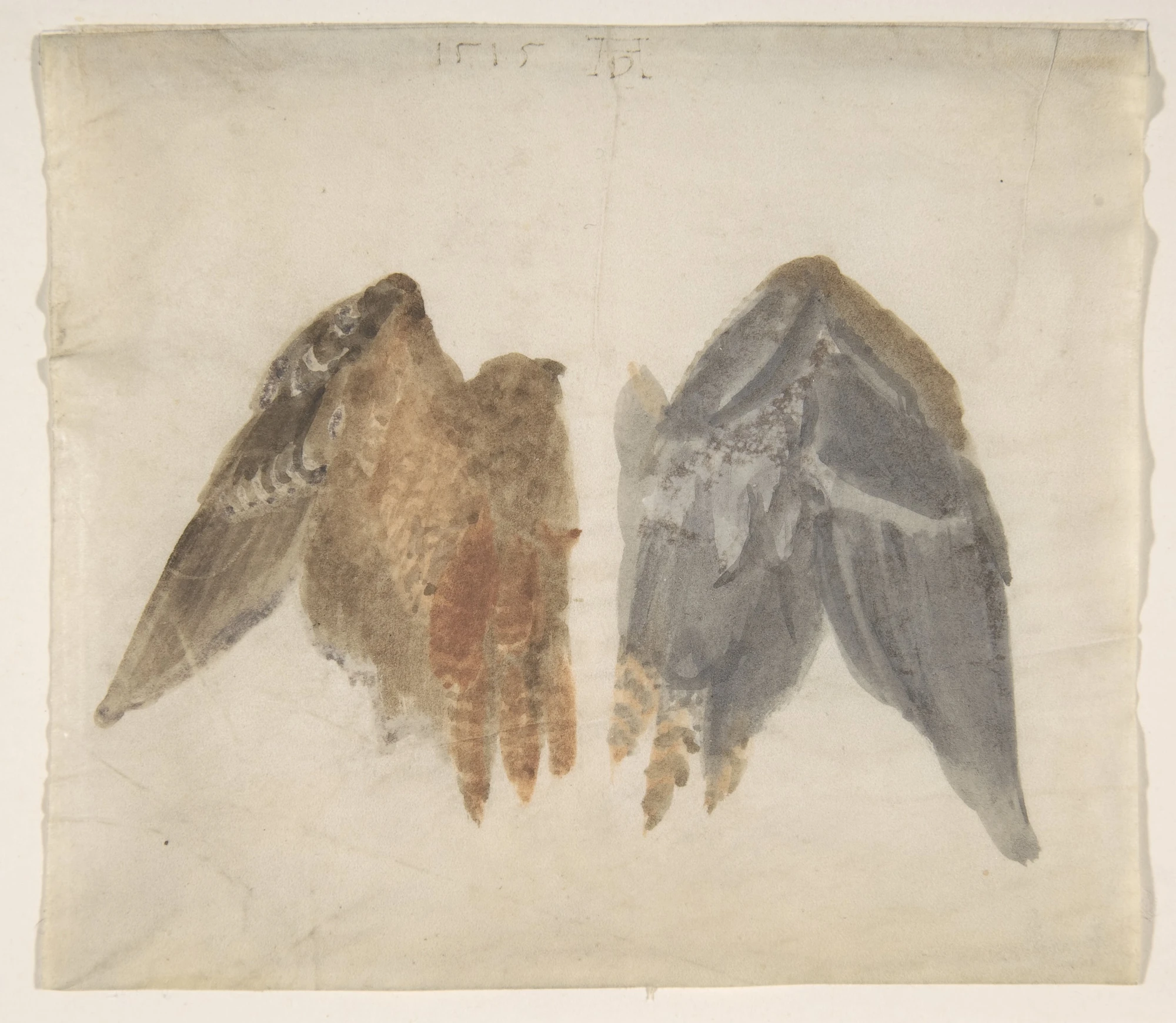
The Bittern's Wings watercolor — a study of a dead bird's spread wings, painted with the precision of a zoological specimen — belongs to the same mind that wrote the Underweysung der Messung, a treatise on geometry and measurement that would influence artists and mathematicians for generations. The wings are not beautiful in a conventional sense. They are true. Every feather is observed, counted, placed. This is art as empirical investigation.
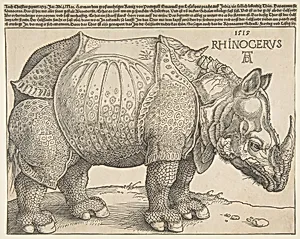
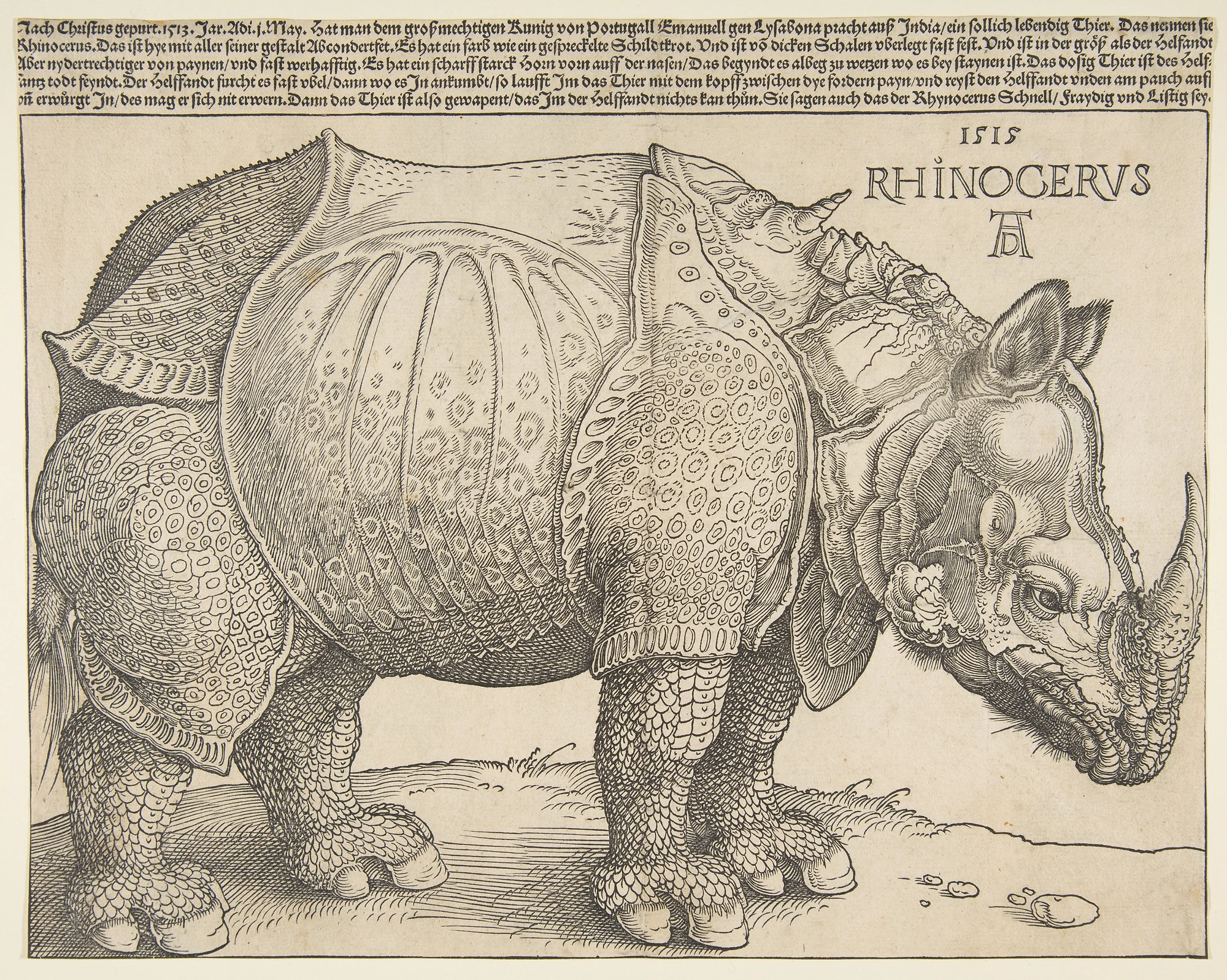
Then there is The Rhinoceros. Dürer never saw one. In 1515, a live rhinoceros arrived in Lisbon — the first seen in Europe since Roman times — and someone sent Dürer a sketch and a description. From this secondhand information, he created a woodcut so authoritative that it remained the standard European image of a rhinoceros for nearly three hundred years, long after people could see real ones. His rhinoceros wears what appears to be armor plating, with a small extra horn on its back that no actual rhinoceros possesses. It is a magnificent fiction that became fact through sheer artistic conviction.
Before the master prints, before the Italian synthesis, the young Dürer made his name with violence.
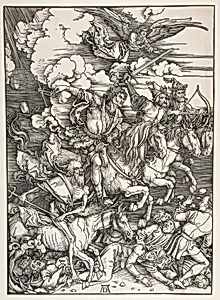
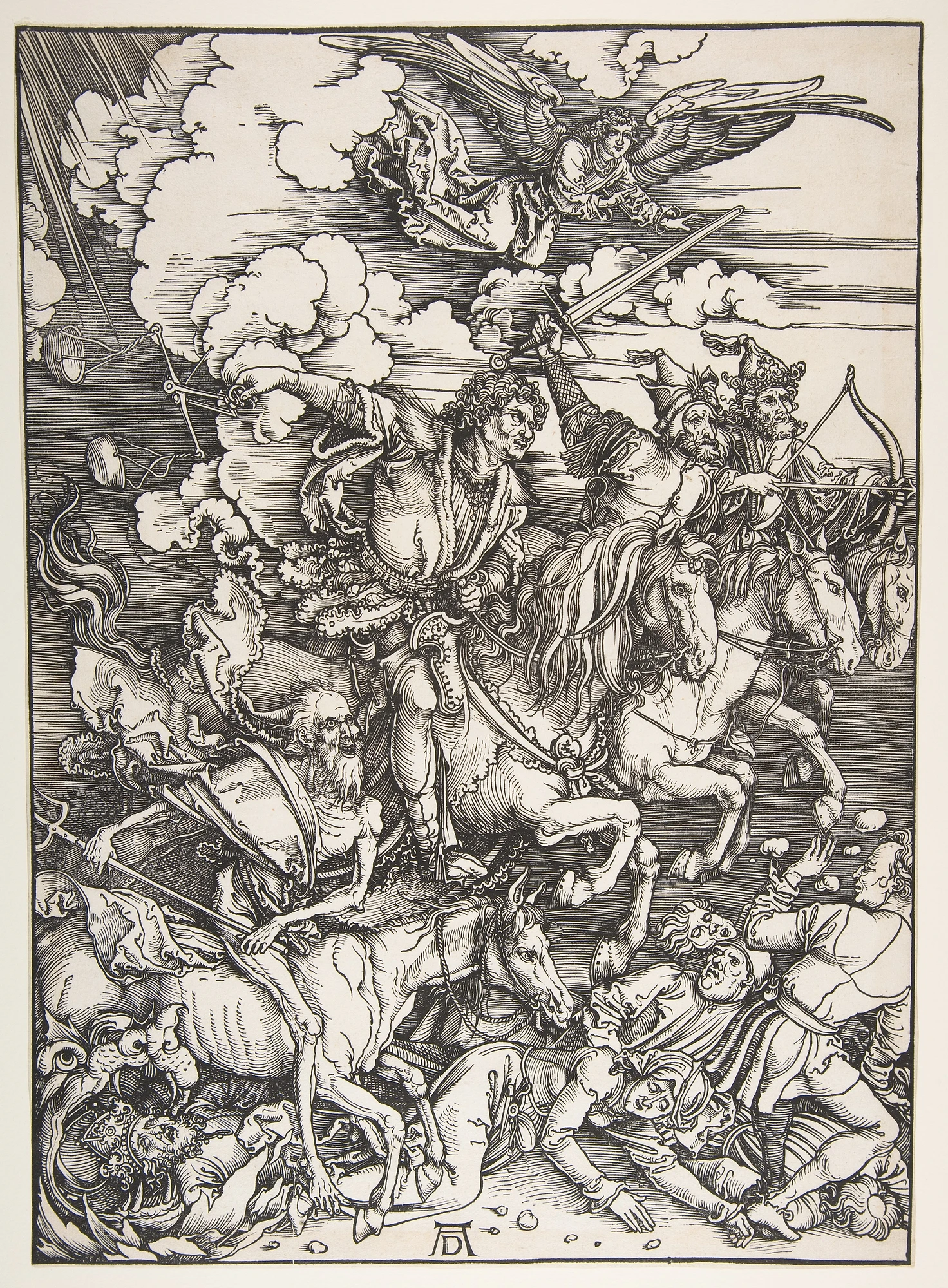
The Four Horsemen of the Apocalypse — part of a fifteen-woodcut series illustrating the Book of Revelation — exploded across Europe in 1498. The composition is savage: four riders trample humanity beneath their horses while an angel watches from above. An emperor, a bishop, and a merchant are devoured equally. The woodcut technique is rough, furious, nothing like the delicate engravings to come. But the energy is volcanic. Dürer was twenty-seven, and he was terrified of the end of the world — everyone was, with 1500 approaching like a deadline.
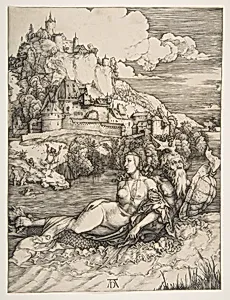
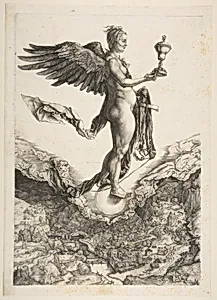
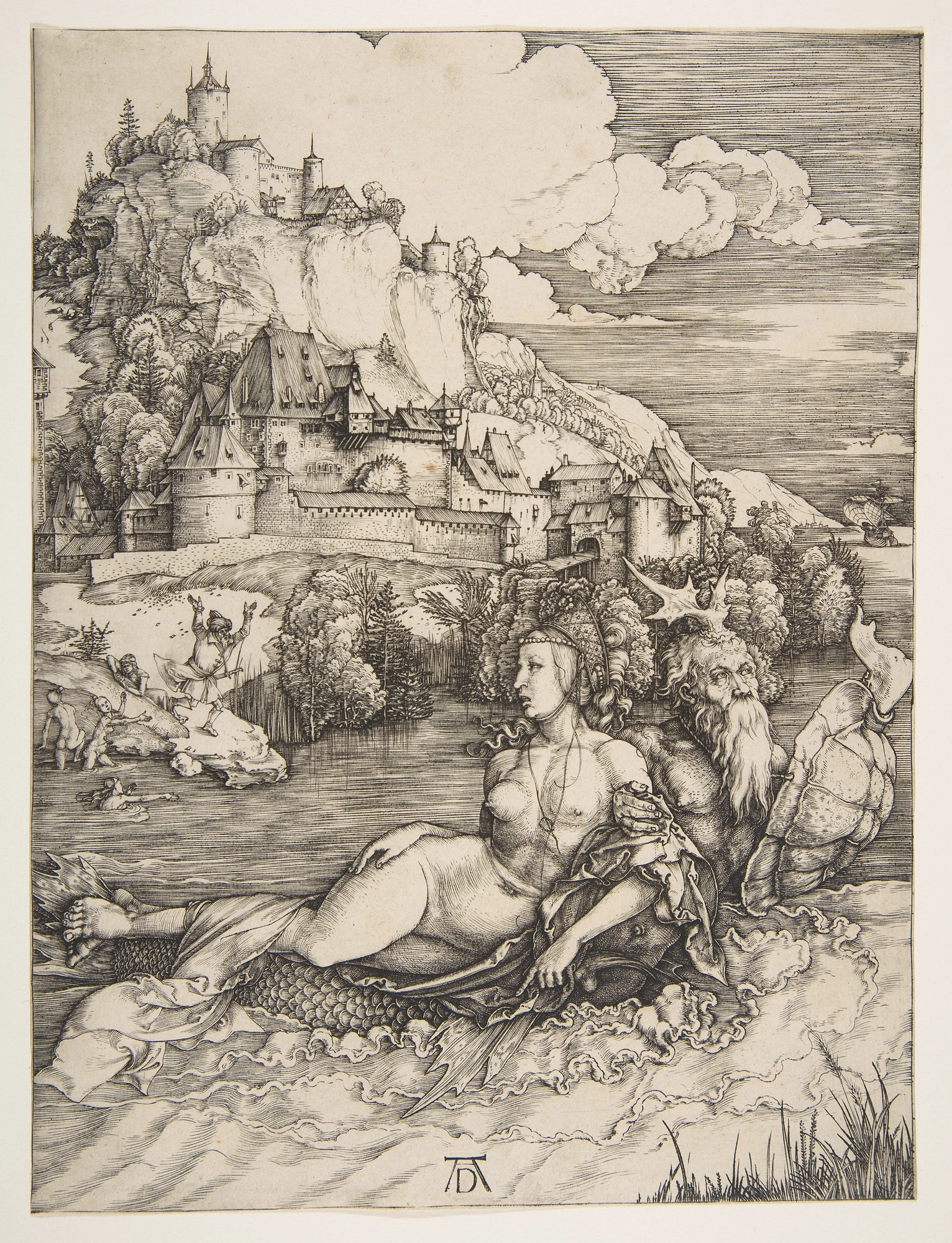
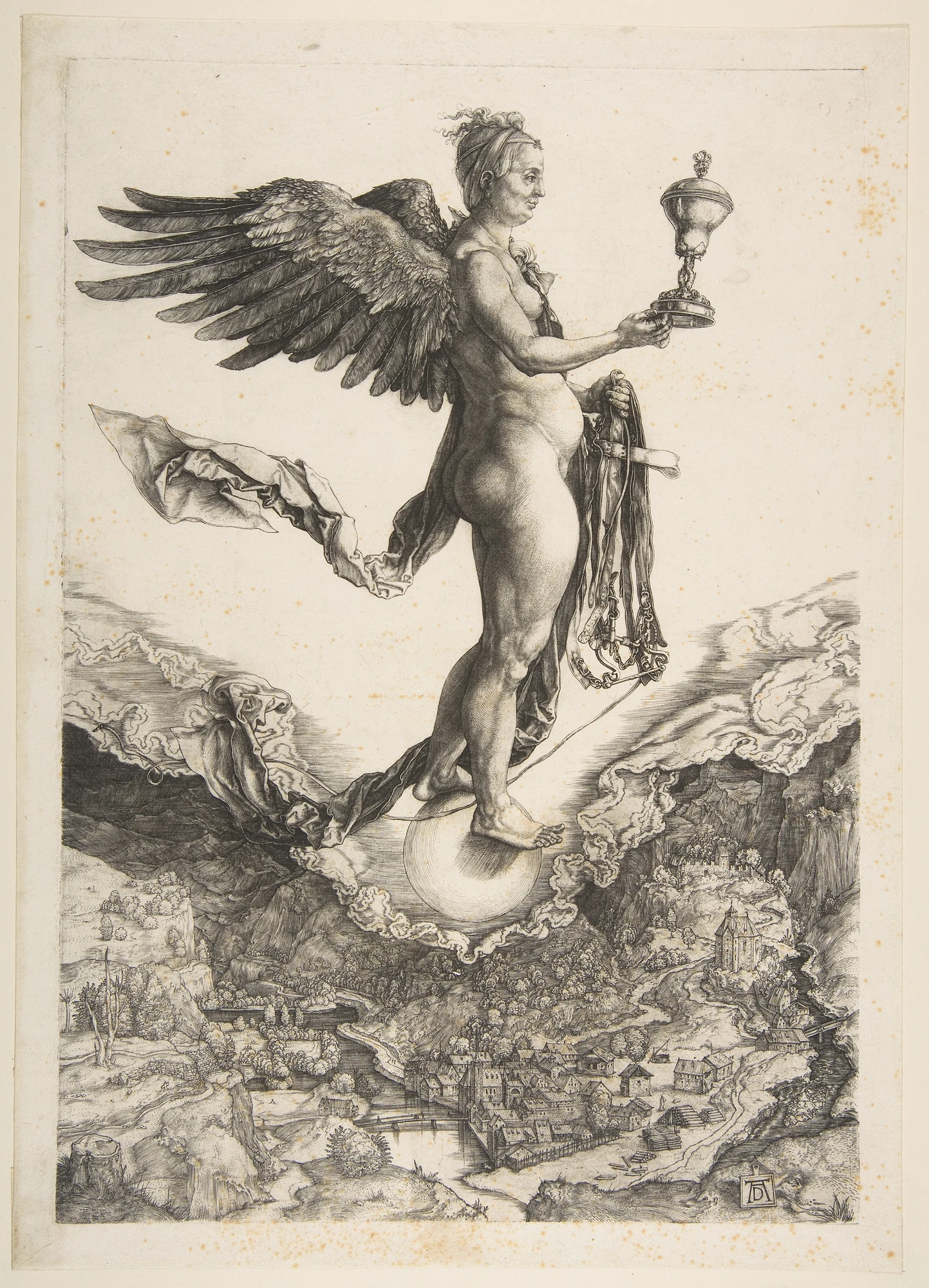
The Sea Monster and Nemesis (The Great Fortune) come from the same period of mythological anxiety. The Sea Monster shows a naked woman carried across water by a scaly creature while her companions scream from the shore. Nemesis — a massive nude female figure standing on a globe — holds a bridle and a goblet: instruments of control and excess.
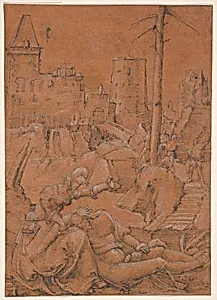
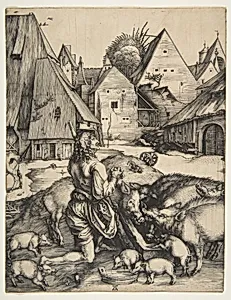
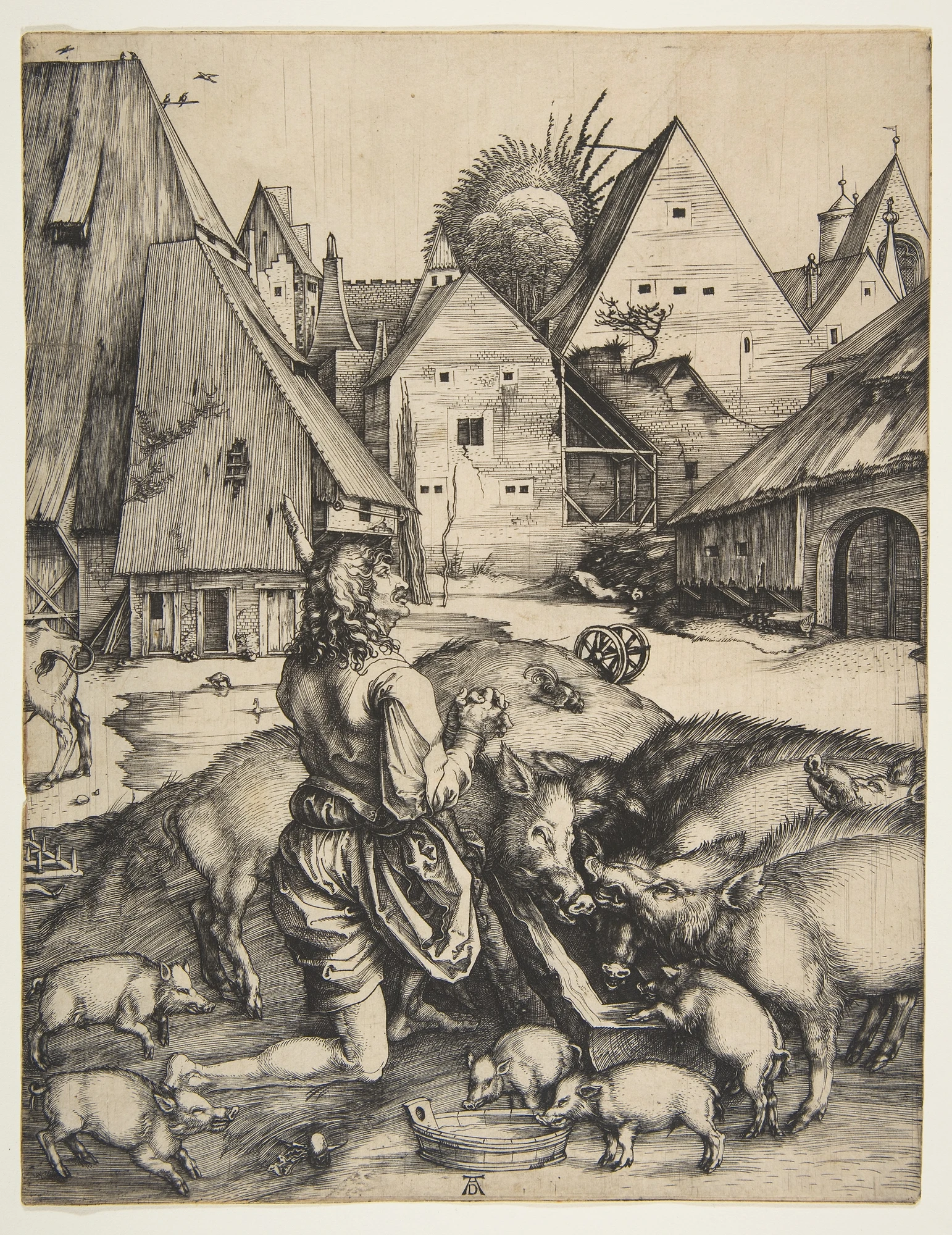
Even The Prodigal Son — ostensibly a New Testament parable — is set in a specific, recognizable German farmyard. The sinner kneels among actual pigs, in actual mud, beside actual half-timbered buildings. Dürer's genius was to make the eternal local.
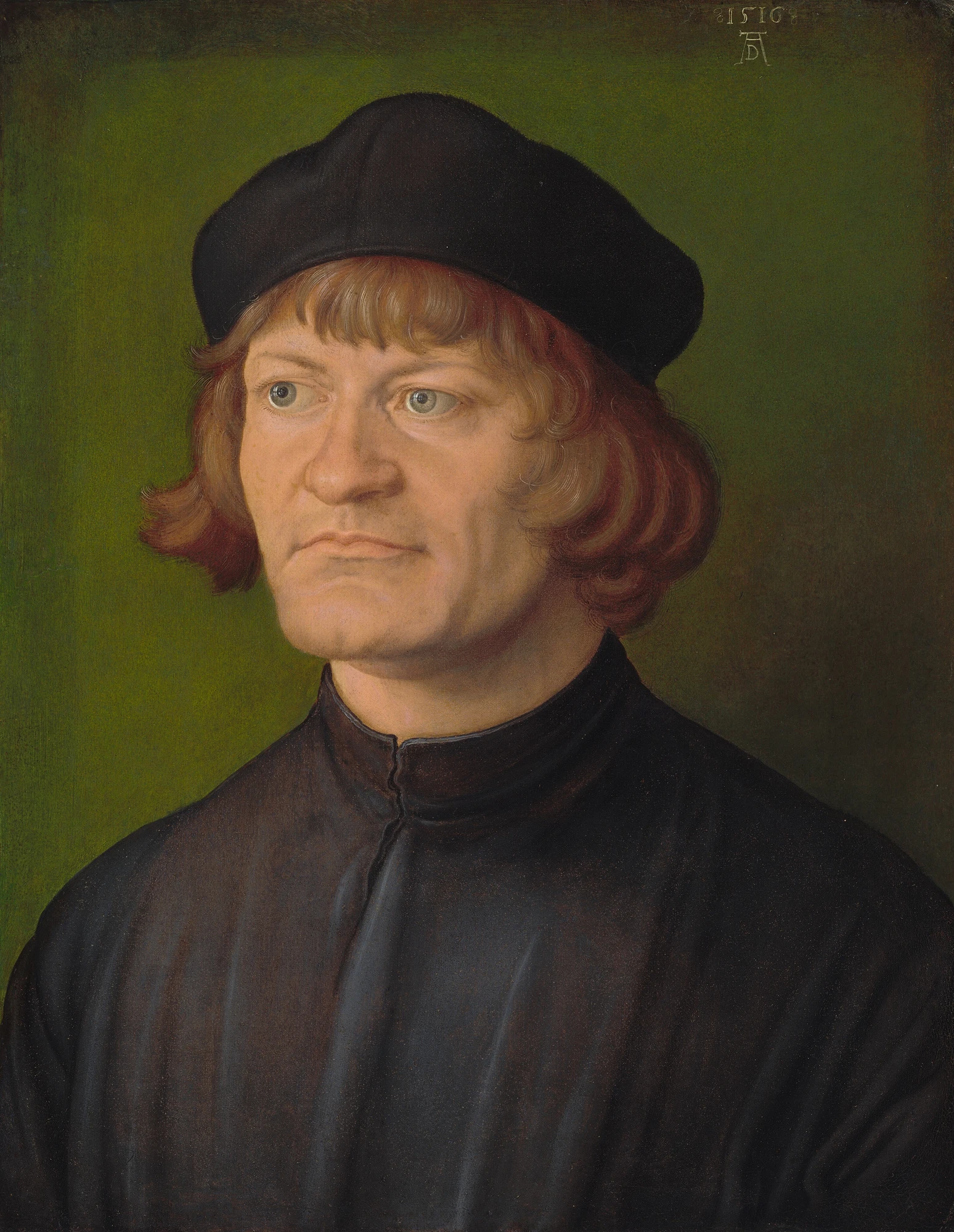
In his later years, Dürer became one of Europe's great portraitists. Not because he flattered his subjects — he did the opposite. He recorded them.
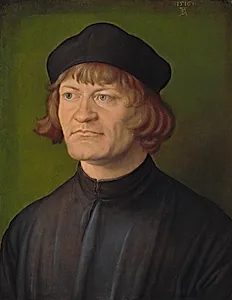
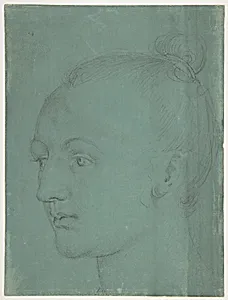
The Portrait of a Clergyman at the National Gallery shows a man whose face has been sculpted by decades of conviction and doubt. The Head of a Young Woman drawing — black and white chalk on green paper — captures a glance of such specificity that you feel she might look away at any moment.
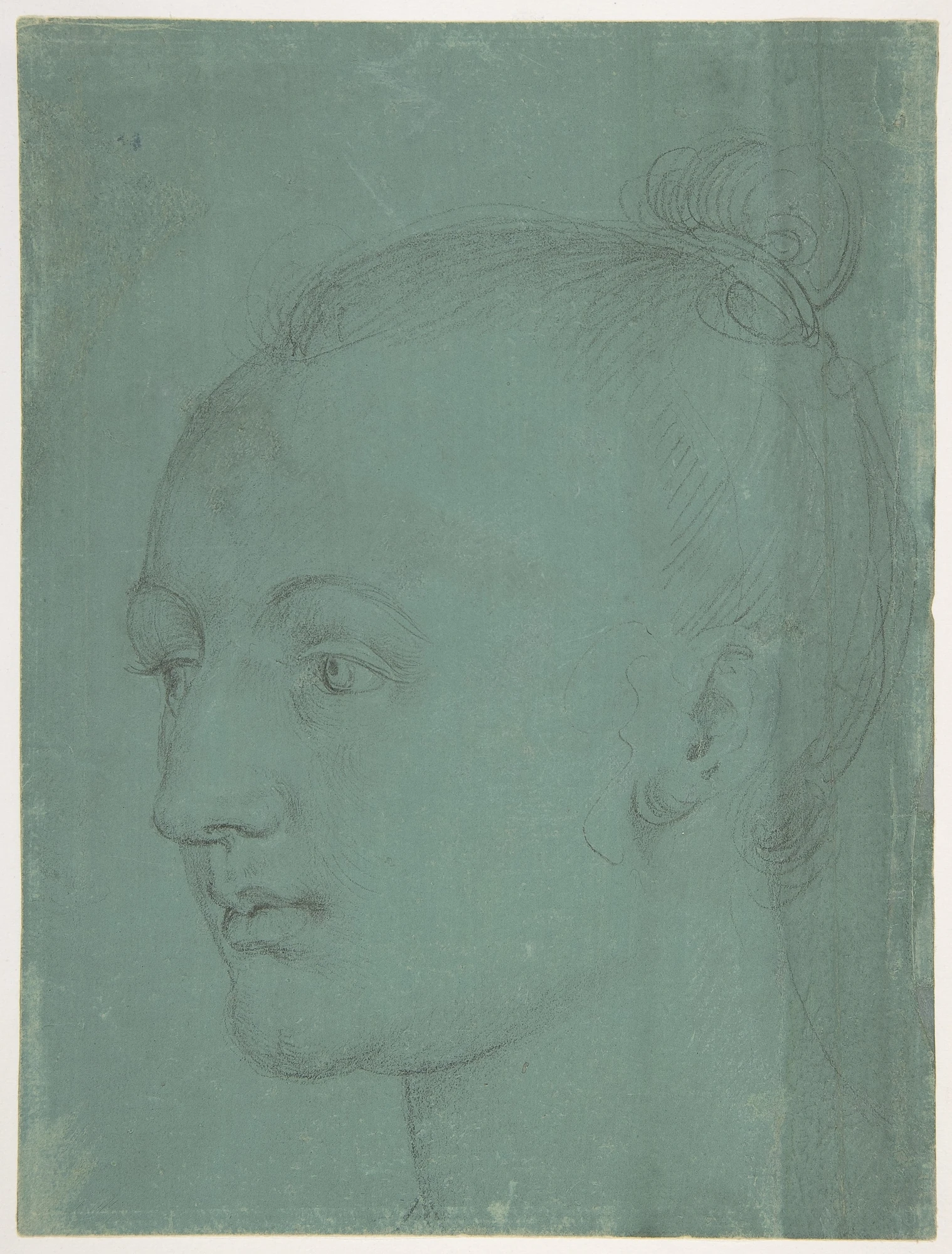
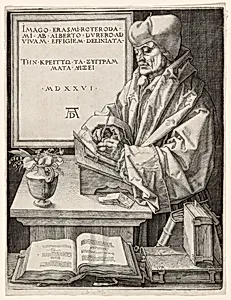
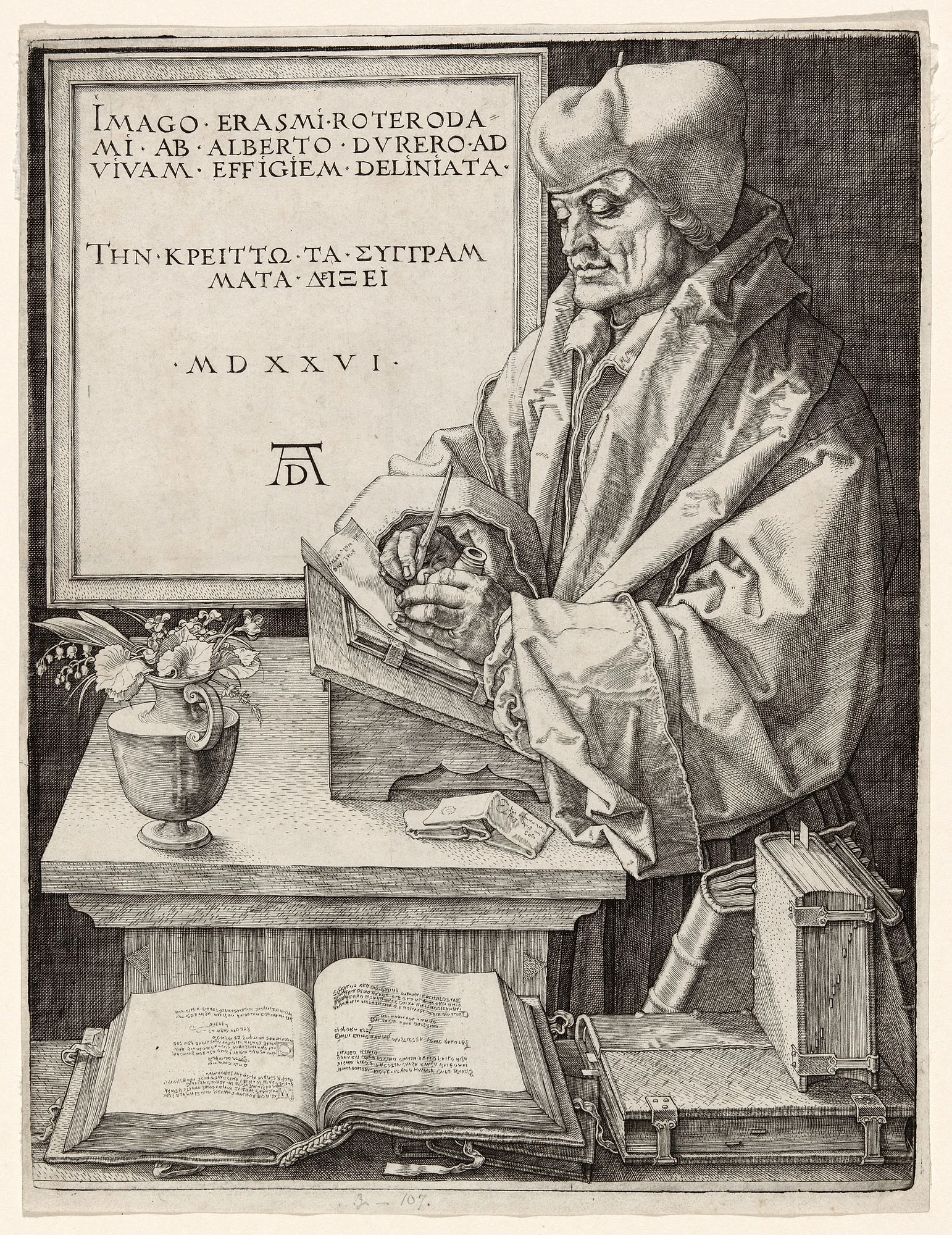
And the Erasmus of Rotterdam engraving, created just two years before Dürer's death, renders the greatest scholar of the age as a man at work: not posing, not performing, simply writing. The books on his shelf have readable spines. The flowers in the vase are identifiable species. For Dürer, a portrait was an act of witness.
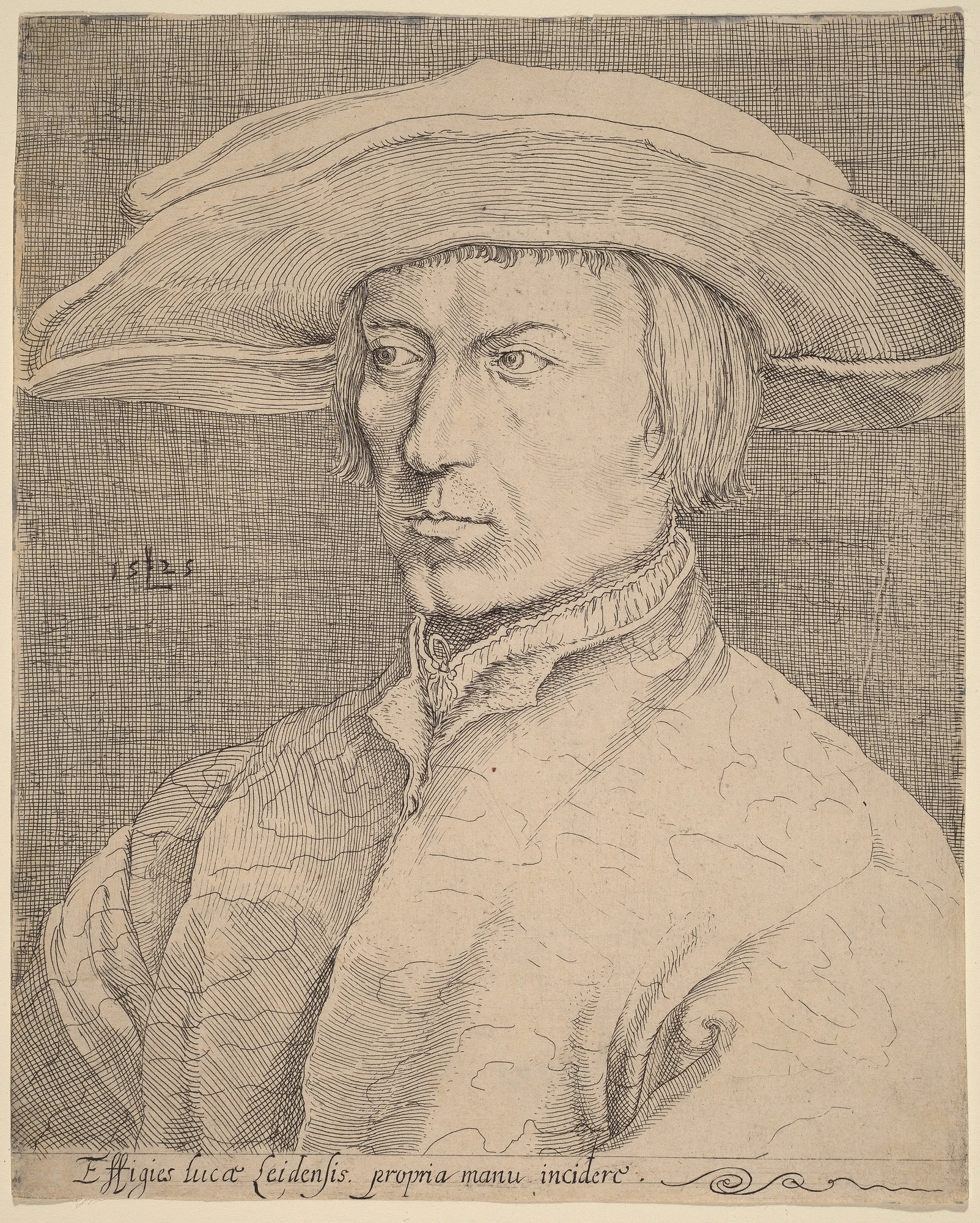
His final Self-Portrait etching of 1525, three years before his death, shows no trace of the Christ-like young man of 1500. The face is gaunt, exhausted, honest. He looks at himself — and at us — without any illusion left. It is the bravest self-portrait in European art: an artist finally seeing exactly what is there.
Dürer died on April 6, 1528, at fifty-six. He left behind roughly 900 surviving works — more documented output than any previous European artist. He invented the concept of the artist's monogram as a brand. He fought the first known copyright case in art history (against Italian engravers copying his prints). He wrote treatises on human proportion, geometry, and fortification. He was a painter, engraver, woodcutter, watercolorist, mathematician, writer, publisher, and diplomat.
But his deepest invention was the idea that being an artist is not a job. It is an identity. When he painted himself as Christ, he was not claiming divinity. He was claiming equality with every other creator — and insisting that the rest of the world acknowledge it.
Five centuries later, we still do.
This exhibition presents 22 works by Albrecht Dürer drawn from four major museum collections: The Metropolitan Museum of Art (New York), the National Gallery of Art (Washington, D.C.), the Art Institute of Chicago, and the Rijksmuseum (Amsterdam). Together, they trace the arc of a life that changed what it means to make art.
Curator
Vasily Gnuchev
Start Date
4/2/2026
End Date
4/2/2027
Visibility
Public
oil on panel
![Madonna and Child [obverse]](https://images.artheonmuseum.org/nga/thumb/madonna-and-child-obverse-nga-41598.webp)
![Lot and His Daughters [reverse]](https://images.artheonmuseum.org/nga/thumb/lot-and-his-daughters-reverse-nga-41599.webp)