
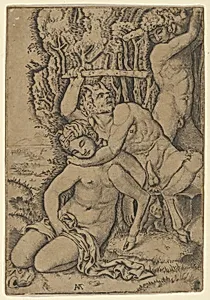
A satyr fighting for a nymph
ca. 1510–20
Medium
Engraving
Dimensions
Sheet: 4 5/8 × 3 1/8 in. (11.7 × 8 cm)
Classification
Prints
Department
Drawings and Prints
Museum
Metropolitan Museum of Art, New York, NY
Credit
The Elisha Whittelsey Collection, The Elisha Whittelsey Fund, 1949
Accession Number
49.97.101
Rights
Public Domain
Tags
Art Historical Context
In the early 16th century, Italian Renaissance artists like Francesco Francia, a leading painter from Bologna, and master engraver Marcantonioondi collaborated to bring classical myths to life through print. *A Satyr Fighting for a Nymph* (ca. 1510–20) is a delicate engraving, measuring just 4 5/8 × 3 1/8 inches, capturing a dynamic mythological struggle. Francia likely designed the composition, while Raimondi’s precise burin work translated it into intricate lines, making high-art imagery accessible beyond elite patrons. This scene draws from ancient Greek lore, where satyrs—half-man, half-goat creatures embodying wild desire—pursue elusive nymphs, symbols of nature’s purity. The nude male satyr’s muscular form contrasts with the nymph’s graceful evasion, highlighting Renaissance fascination with antiquity, anatomy, and human emotion. Engravings like this revolutionized art dissemination, allowing collectors across Europe to own affordable replicas of original designs. Housed in the Metropolitan Museum of Art’s Drawings and Prints department, this print exemplifies the technical virtuosity of Raimondi, who elevated engraving to rival painting. Visitors will appreciate its lively energy and the era’s blend of pagan revelry with refined humanism.
About the Artist
Francesco Francia|Marcantonio Raimondi · 1447–1517
Influential Bolognese painter of his period, noted for sweet, softly rounded Madonnas and portraits. Influenced by Costa, his partner, and by Perugino. Comment on works: Religious