
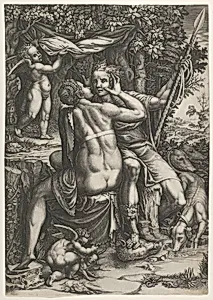
Venus and Adonis
ca. 1570
Medium
Engraving
Dimensions
Sheet: 12 5/8 x 8 7/8 in. (32 x 22.5 cm)
Classification
Prints
Department
Drawings and Prints
Museum
Metropolitan Museum of Art, New York, NY
Credit
The Elisha Whittelsey Collection, The Elisha Whittelsey Fund, 1953
Accession Number
53.522.28
Rights
Public Domain
Tags
Art Historical Context
In the grand tradition of Renaissance mythology, *Venus and Ad* (ca. 1570 captures a pivotal moment from Ovid's *Metamorphoses Engraved by the master Italian printmaker Giorgio Ghisi, possibly in collaboration with Teodoro Gh, the scene features the goddess Venus desperately clinging to her mortal lover Adonis, accompanied by the winged Cupid and loyal hounds. This poignant depiction highlights Venus's futile plea for Adonis to abandon his hunt, foretelling his tragic death by a boar's tusk—a timeless tale of love, passion, and mortality that captivated 16th-century audiences. As an engraving, this work exemplifies the technical virtuosity of the medium during the Mannerist era. Ghisi's intricate line work on a copper plate allowed for exceptional detail in textures—from the flowing drapery of Venus's gown to the muscular forms of Adonis and the dogs' alert fur—while enabling widespread dissemination of classical themes to collectors across Europe. Measuring 12 5/8 x 8 7/8 inches, its intimate scale belies its monumental emotional impact. Housed in the Metropolitan Museum of Art's Drawings and Prints department, this print from The Elisha Whittelsey Collection underscores the Renaissance revival of antique stories, blending eroticism with moral reflection. A testament to printmaking's role in democratizing high art, it invites visitors to ponder the fragile beauty of desire.
About the Artist
Giorgio Ghisi|Teodoro Ghisi · 1520–1582
Giorgio Ghisi (c. 1520–1582) was one of the most accomplished engravers of the Italian Renaissance, renowned for translating the monumental compositions of Raphael, Giulio Romano, and Michelangelo into the exacting medium of the burin. Born in Mantua, he trained in an environment shaped by the legacy of Giulio Romano's decoration of the Palazzo del Te, and the grandeur of that Mannerist tradition ...