
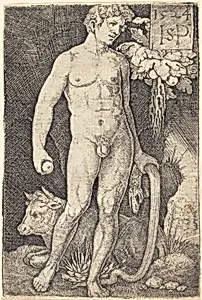
Adam Standing
1524
Medium
engraving
Classification
Department
CG-E
Museum
National Gallery of Art, Washington, D.C.
Credit
Rosenwald Collection
Accession Number
1943.3.1159
Rights
Public Domain
Art Historical Context
In the National Gallery of Art Rosenwald Collection, *Adam Standing* (1524) by Sebald Beham showcases the artist's mastery of the engraving medium. This precise print depicts the biblical figure of Adam in a poised, naturalistic stance, rendered with fine lines that capture anatomical detail and subtle musculature. As a small-scale work classified under Prints in Department CG-E, it exemplifies the Renaissance fascination with the human form, drawing from classical ideals while rooted in Northern European traditions. Sebald Beham, a Nuremberg-born artist (1500–1550) and one of the "Little Masters" of German printmaking, produced this during the Northern Renaissance. Expelled from Nuremberg in 1524 for his Protestant leanings amid religious turmoil, Beham turned to engraving—a technique using a burin to incise metal plates, allowing for intricate details and multiple impressions. His style, influenced by Albrecht Dürer, features meticulous line work that rivals painting in depth, making complex narratives accessible. This engraving holds cultural importance as a study in male nudity and humanism, bridging biblical storytelling with emerging scientific interest in anatomy. Visitors will appreciate its technical virtuosity, a testament to how prints democratized art in the 16th century.
About the Artist
Sebald Beham · 1500–1550
Sebald Beham (1500–1550), a pioneering German printmaker and painter born in Nuremberg, emerged as one of the most prolific artists of the Northern Renaissance. The elder brother of fellow artist Barthel Beham, he grew up in a milieu steeped in artistic tradition, though details of his early training remain sparsely documented. Recorded as a journeyman painter (Malergeselle) by 1521 and a master w...