
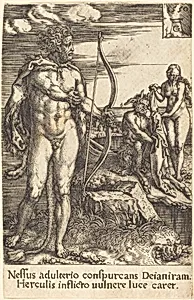
Hercules Killing Nessus
Classification
Department
CG-E
Museum
National Gallery of Art, Washington, D.C.
Credit
Rosenwald Collection
Accession Number
1943.3.259
Rights
Public Domain
Art Historical Context
Behold *Hercules Killing Ness* (1550), a captivating print by Heinrich Aldegrever, a masterful German engraver of the Northern Renaissance. Aldegrever, part of the esteemed "Little Masters" known for their intricate small-scale works, crafted this piece during a time when artists eagerly revived classical mythology amid the humanist fervor of the 16th century. Housed in the National Gallery of Art's Rosenwald Collection (Department CG-E), it exemplifies the era's fascination with heroic tales from ancient Greece, blending moral allegory with virtuoso technique. The scene captures the climactic moment from the myth of Hercules, the mighty demigod, slaying the centaur Nessus. In Ovid's *Metamorphoses*, Nessus attempts to abduct Hercules' wife, Deianira, prompting the hero's fatal arrow shot—blood from which later proves tragically poisonous. Aldegrever's print likely renders this drama with fine, precise lines characteristic of engraving, emphasizing dynamic poses, muscular anatomy, and dramatic tension to evoke the raw power of legend. As a Renaissance print, it served not just as art but as a portable narrative, spreading classical stories to scholars and collectors across Europe. Its survival in the Rosenwald Collection underscores the enduring value of Aldegrever's technical brilliance, inviting us to ponder timeless themes of jealousy, heroism, and unintended consequences. (198 words)
About the Artist
Heinrich Aldegrever · 1502–1561
Heinrich Aldegrever, born in 1502 in Paderborn, Westphalia, to parents Herman and Katherine Trippenmeker—a family of clog-makers known by the dialect name Trippenmecker—emerged as a multifaceted artist in the German Renaissance. His early training remains undocumented, though he likely apprenticed in a Soest goldsmith's workshop after relocating there around 1525, where he joined the painters' gui...