
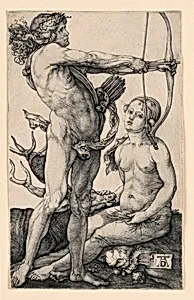
Apollo and Diana
Classification
Department
Smithsonian Collection
Museum
Smithsonian American Art Museum
Credit
Gift of Leo Wallerstein
Accession Number
1951-170-38
Rights
Public Domain
About this artwork
Research in Progress
Art Historical Context
Albrecht Dürer (1471–1528), one of the greatest artists of the Northern Renaissance, revolutionized printmaking with his extraordinary technical precision and expressive power. Working in Germany during a time when Renaissance humanism was blending classical antiquity with northern realism, Dürer mastered woodcuts and engravings, producing works that were both affordable art and vehicles for intellectual ideas. His prints, often signed with his distinctive "AD" monogram, circulated widely across Europe, making him an international celebrity in his lifetime. *Apollo and Diana*, created around 1505 and classified as a print, draws on classical mythology to depict the sun god Apollo—patron of music, poetry, and prophecy—and his twin sister Diana, goddess of the hunt and the moon. This subject reflects the Renaissance fascination with Greco-Roman gods, symbolizing harmony between the arts and nature, masculine and feminine ideals. Though the exact medium remains unspecified, Dürer's prints typically showcase meticulous line work, intricate details, and a sense of depth that rivaled painting, elevating the print from mere reproduction to high art. Housed in the Smithsonian American Art Museum as a gift from Leo Wallerstein, this piece exemplifies Dürer's enduring legacy in bridging Italian classicism with Germanic precision. Ongoing research promises to uncover more about its creation and reception, inviting visitors to ponder its timeless allure.