
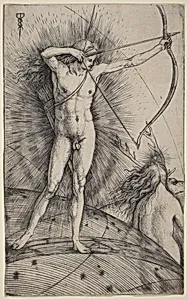
Apollo and Diana
c. 1503
Medium
engraving
Dimensions
sheet (trimmed to plate mark): 16 x 9.8 cm (6 5/16 x 3 7/8 in.)
Classification
Department
CG-E
Museum
National Gallery of Art, Washington, D.C.
Credit
Gift of W.G. Russell Allen
Accession Number
1941.1.4
Rights
Public Domain
Art Historical Context
Created around 1503 by the Venetian artist Jacopo de’ Barbari, *Apollo and Diana* is a delicate engraving that captures the refined elegance of the early Renaissance. Working at the crossroads of Italian and Northern European traditions, de’ Barbari introduced the precise linear techniques of Italian draftsmanship to printmaking in Germany and the Netherlands. His small engraving—measuring just 16 by 9.8 centimeters—demonstrates how the medium allowed artists to circulate classical imagery with remarkable clarity and detail to a growing audience of collectors and scholars. The subject reflects the Renaissance fascination with ancient mythology. Apollo, god of light and the arts, stands beside his twin sister Diana, goddess of the moon and the hunt. Rendered with graceful proportions and subtle modeling, the figures embody the period’s renewed interest in harmonious human forms drawn from classical sources. As a print, the work could travel widely, helping to spread these ideals across Europe. Today, this rare impression in the National Gallery of Art’s collection offers visitors an intimate glimpse into the moment when printmaking became a powerful vehicle for artistic and intellectual exchange.
About the Artist
Jacopo de' Barbari · 1497–1516
Jacopo de' Barbari (c. 1460/70–before 1516) was an Italian painter, printmaker, and miniaturist of Venetian background whose career unfolded across the courts and workshops of northern Europe, making him one of the most important conduits between Italian Renaissance art and the northern artistic tradition in the years around 1500. Little is known of his training or his early decades; Alvise Vivari...