
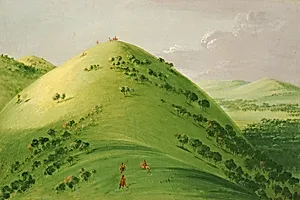
Beautiful Prairie Bluffs, Upper Mississippi
1835-1836
Medium
Painting
Classification
Painting
Department
Smithsonian Collection
Museum
Smithsonian American Art Museum
Credit
Smithsonian American Art Museum, Gift of Mrs. Joseph Harrison, Jr.
Accession Number
1985.66.329
Rights
Public Domain
Tags
About this artwork
When George Catlin made his first trips up the Missouri River in 1830 and 1832, he was enraptured by the landscape. Though he had worked as a portraitist in Philadelphia and originally intended to paint Native Americans themselves, he felt compelled to depict their prairies, rivers, and hills as well. Catlin wrote: “There is no more beautiful prairie country in the world, than that which is to be seen in this vicinity . . . The surface of the country is gracefully and slightly undulating, like t...
Art Historical Context
George Catlin, a pioneering 19th-century American artist, captured the wild beauty of the American West his expeditions along the Missouri and Mississippi Rivers in the 1830s. Originally a portrait painter from Philadelphia, Catlin set out to document Native American life but found himself equally enchanted by the untamed landscapes. *Beautiful Prairie Bluffs, Mississippi* (18351836), an oil painting now in the Smithsonian American Art, reflects this passion, showcasing the rolling prairie hills along the Upper Mississippi as graceful "ocean swells" after a storm—a phrase straight from Catlin's own writings. In this work, Catlin masterfully conveys the vast, undulating plains that defined the frontier, evoking a sense of awe at nature's grandeur. His trips, made before widespread European settlement transformed these regions, preserved a vision of pristine wilderness on canvas. As one of the earliest artists to systematically depict the American interior, Catlin's romantic style bridged portraiture and landscape painting, influencing later movements like the Hudson River School. This painting invites visitors to imagine the thrill of exploration, reminding us of the cultural and ecological significance of these prairies—home to Native peoples and a symbol of America's expansive promise. (198 words)
About the Artist
George Catlin · 1796–1872
George Catlin (1796–1872), born in Wilkes-Barre, Pennsylvania, to Putnam Catlin and Polly Sutton—who had been captured by Native Americans during the 1778 Battle of Wyoming—initially pursued a legal career. Trained at Litchfield Law School, he was admitted to the bar in 1819 but abandoned law after two years to study art in Philadelphia in 1823. Self-taught as a portraitist, Catlin quickly gained ...