
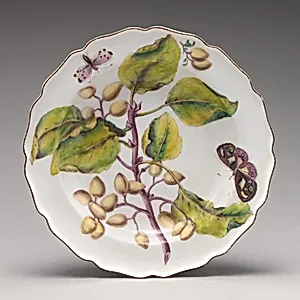
Botanical plate with fruiting branch
ca. 1755
Medium
Soft-paste porcelain with enamel decoration
Dimensions
Overall (confirmed): 1 9/16 × 9 1/8 × 9 1/8 in., 1 lb. (4 × 23.2 × 23.2 cm, 0.5 kg)
Classification
Ceramics-Porcelain
Culture
British, Chelsea
Department
European Sculpture and Decorative Arts
Museum
Metropolitan Museum of Art, New York, NY
Credit
Purchase, Bequest of Bernard M. Baruch, by exchange, 2016
Accession Number
2016.222
Rights
Public Domain
Tags
Art Historical Context
This exquisite *Botanical plate with fruiting branch*, produced by the Chelsea Porcelainufactory around 1755, exemplifies the age of British porcelain making. Chelsea, one of England's pioneering factories (active 1743–1769), specialized in soft-paste porcelain delicate, bone-ash-based material fired at lower temperatures than true-paste, allowing for intricate modeling and vibrant enamel colors. This technique, inspired by Chinese and Meissen wares, fueled Europe's 18th-century porcelainze, positioning Chelsea as a rival in luxury decorative arts. Measuring just 9⅛ inches across and weighing a mere pound, the plate features a meticulously painted fruiting branch adorned with butterflies, capturing nature's abundance in vivid enamels. These naturalistic motifs reflect the Rococo era's love for organic elegance and scientific curiosity during the Enlightenment, when botanical illustrations proliferated. The butterflies add whimsy and realism, showcasing the factory's skilled overglaze enameling, applied and fired multiple times for jewel-like depth. Now in the Metropolitan Museum of Art's European Sculpture and Decorative Arts collection—acquired through the Bequest of Bernard M. Baruch—this plate invites visitors to appreciate how Chelsea porcelain blended artistry, innovation, and the era's fascination with the natural world. A true tabletop treasure!
About the Artist
Chelsea Porcelain Manufactory · 1744–1784
**Chelsea Porcelain Manufactory** The Chelsea Porcelain Manufactory, Britain's pioneering porcelain enterprise, was founded around 1743 in Chelsea, London, by two Huguenot silversmiths: Nicholas Sprimont from Liège and Charles Gouyn. Sprimont, trained in Paris as a goldsmith before immigrating to England, brought his expertise in luxury metalwork to the venture, while Gouyn handled early sales th...