
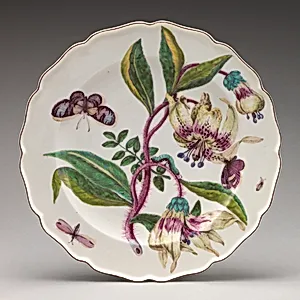
Botanical plate with spray of lilies
ca. 1755
Medium
Soft-paste porcelain with enamel decoration
Dimensions
Overall (confirmed): 1 1/4 × 11 × 11 in. (3.2 × 27.9 × 27.9 cm)
Classification
Ceramics-Porcelain
Culture
British, Chelsea
Department
European Sculpture and Decorative Arts
Museum
Metropolitan Museum of Art, New York, NY
Credit
Purchase, Sidney R. Knafel Gift, in honor of Jeffrey Munger, 2016
Accession Number
2016.223
Rights
Public Domain
Tags
Art Historical Context
This exquisite botanical plate from the Chelseacelain Manufactory, to around 1755, exemplifies golden age of British porcelain production. Chelsea, one of England's earliest porcelain factories established in the 1740s, in soft-paste porcelain delicate, translucent material fired at lower temperatures than true-paste Chinese porcelain. This 11-inch square plate, vibrantly decorated with enamels, captures a lush spray of lilies accompanied by fluttering butterflies, blending naturalistic precision with Rococo elegance. The enamel overglaze technique allowed artisans to apply vivid colors—whites, greens, and subtle pinks—that wouldn't fade under repeated handling, making such pieces prized for dining tables and cabinets. Botanical motifs like these lilies drew from contemporary scientific illustrations and gardens, reflecting the era's fascination with nature amid the Enlightenment. Butterflies added a whimsical, symbolic touch, evoking fragility and transformation. As a product of Chelsea's "gold anchor" period, this plate highlights British innovation in rivaling European leaders like Meissen and Sèvres. Now at The Metropolitan Museum of Art, it invites visitors to appreciate how 18th-century decorative arts merged artistry, science, and luxury in everyday objects.
About the Artist
Chelsea Porcelain Manufactory · 1744–1784
**Chelsea Porcelain Manufactory** The Chelsea Porcelain Manufactory, Britain's pioneering porcelain enterprise, was founded around 1743 in Chelsea, London, by two Huguenot silversmiths: Nicholas Sprimont from Liège and Charles Gouyn. Sprimont, trained in Paris as a goldsmith before immigrating to England, brought his expertise in luxury metalwork to the venture, while Gouyn handled early sales th...