
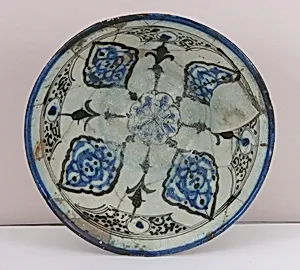
Bowl
Unknown Artist
13th century
Medium
Stonepaste; painted under transparent glaze
Dimensions
H. 4 3/8 in. (11.1 cm) Diam. 9 in. (22.9 cm)
Classification
Ceramics
Department
Islamic Art
Museum
Metropolitan Museum of Art, New York, NY
Credit
Milton A. Rauh and Florence L. Goldmark Collection, Bequest of Florence L. Goldmark, 1974
Accession Number
1974.161.11
Rights
Public Domain
Art Historical Context
This elegant 13th-century stonepaste bowl, hailing from the Islamic world, exemplifies the masterful ceramics of the medieval Middle East. Crafted with a body of stonepaste—a composite of quartz, clay, and frit that mimics the translucency of porcelain—this wide, shallow vessel (9 inches in diameter, 4⅜ inches high) features paintings applied under a transparent glaze. This technique, perfected by artisans in regions like Persia, Syria, and Egypt, allowed vibrant colors and fine details to shine through, creating luminous effects prized by collectors and users alike. Stonepaste ware emerged around the 10th century as an Islamic innovation, compensating for the lack of true porcelain in the West. By the 13th century, amid flourishing trade routes and cultural exchanges, these bowls served both practical purposes—holding food or water—and decorative ones, often adorning wealthy households. Though the artist remains unknown, the bowl's refined form reflects the era's technical sophistication and aesthetic harmony, blending utility with artistry. Now part of the Metropolitan Museum of Art's Islamic Art collection, gifted through the Milton A. Rauh and Florence L. Goldmark bequest in 1974, this piece invites us to appreciate the ingenuity of anonymous creators whose work bridged everyday life and enduring beauty.