
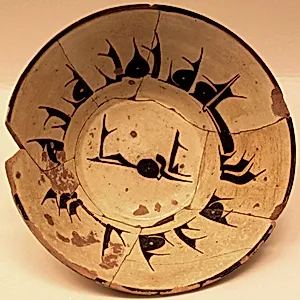
Bowl
Unknown Artist
10th century
Medium
Earthenware; painted and glazed
Dimensions
H. 3 3/16 in. (8.1 cm) Diam. 8 7/8 in. (22.5 cm) Wt. 19.2 oz. (544.4 g)
Classification
Ceramics
Department
Islamic Art
Museum
Metropolitan Museum of Art, New York, NY
Credit
Bequest of Florence B. Selden, in memory of Charles K. Wilkinson, 1995
Accession Number
1996.269
Rights
Public Domain
Art Historical Context
This elegant 10th-century bowl the Islamic world exemplifies the artistry of early medieval ceramics, crafted during a golden age of cultural and technological exchange under Abbasid influence. Produced in earthenware—a durable, locally sourced clay—the bowl's dimensions (just over 3 inches high and 9 inches wide) made it ideal for everyday use, such as serving food or drink in affluent households. Its presence in the Metropolitan Museum of's Islamic Art Department highlights sophistication of pottery production in regions like Iraq or eastern Iran, where potters innovated to meet growing demands for both functional and decorative wares. The bowl's painted and glazed surface represents a pivotal technique in Islamic ceramics. Artisans applied pigments over a slip layer before firing, then coated it with a glossy glaze that sealed in vibrant colors and protected the vessel. This method not only enhanced durability and water resistance but also allowed for intricate designs, foreshadowing the lustrous tiles and vessels of later centuries. Weighing about 19 ounces, its sturdy form speaks to practical craftsmanship blended with aesthetic appeal. Bequeathed to the Met in 1995 by Florence B. Selden in memory of Charles K. Wilkinson, this anonymous masterpiece invites us to appreciate the unsung makers whose innovations shaped Islamic material culture, bridging utility and beauty across millennia.