
Dish
Unknown Artist
14th century
Medium
Earthenware; painted and glazed
Dimensions
H. 1 3/4 in. (4.4 cm) Diam. 8 1/8 in. (20.6 cm) Wt. 12.7 oz. (360.1 g)
Classification
Ceramics
Department
Islamic Art
Museum
Metropolitan Museum of Art, New York, NY
Credit
Rogers Fund, 1967
Accession Number
67.165
Rights
Public Domain
Art Historical Context
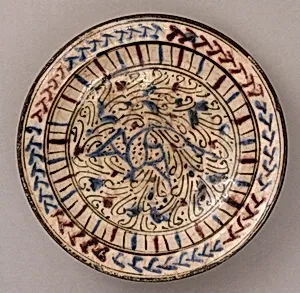
This elegant 14th-century earthen dish, hailing from the Islamic world, exemplifies the refined ceramic traditions of the medieval Islamic courts. Measuring just 1¾ inches high and 8⅛ inches in diameter, its shallow form and modest weight of 12.7 ounces suggest it was designed for practical use—likely as a serving plate for fruits, sweets, or spiced delicacies during communal meals. Acquired through the Rogers Fund in 1967, it now graces the Islamic Art department at The Metropolitan Museum of Art. Crafted from earthenware—a durable, locally sourced clay—the dish's surface was painted with pigments and coated in a glossy glaze, a hallmark technique of Islamic potters. This method created a smooth, impermeable finish that protected the clay while allowing vibrant colors and intricate designs to shine through, often featuring geometric patterns, floral motifs, or Arabic script symbolizing prosperity and beauty. Such glazed wares transformed everyday objects into artistic treasures, reflecting the era's blend of functionality and opulence. In the 14th century, amid flourishing trade routes from Persia to Spain, ceramics like this dish spread Islamic aesthetic influences far and wide. They highlight a cultural emphasis on harmony in design, where form met utility, inviting us to appreciate the anonymous artisan's skill in elevating the ordinary to the extraordinary.