
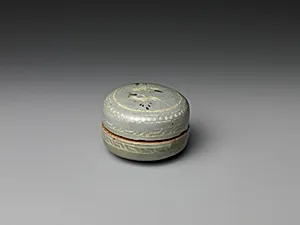
청자 상감 구름 학 무늬 모자합 고려|靑磁象嵌雲鶴文母子盒 高麗|Box from set of five decorated with cranes and clouds
Unknown Artist
13th–14th century
Medium
Stoneware with inlaid design under celadon glaze
Dimensions
H. 1 1/8 in. (2.9 cm); Diam. 1 3/4 in. (4.4 cm)
Classification
Ceramics
Culture & Period
Korea · Goryeo dynasty (918–1392)
Department
Asian Art
Museum
Metropolitan Museum of Art, New York, NY
Credit
Gift of Edna H. Bahr, 1962
Accession Number
62.97.7a, b
Rights
Public Domain
Tags
Art Historical Context
This exquisite celadon box, part of a nested set of five from Korea's Goryeo dynasty918–1392), dates to the 13th–14th century. Craft from stoneware with intricate inlaid designs under a signature jade-green celadon glaze it measures just 1 1/8 inches high and 1 3/4 inches in diameter—small enough to hold cosmetics, jewelry, or precious spices for daily elite use. Produced during the height of Goryeo ceramic artistry, such pieces reflect the dynasty's mastery of high-fired stoneware, prized for its subtle luster and crackle that evoked precious jade. The sanggam (inlaid) technique, a hallmark of Goryeo innovation, involves incising motifs into the clay body, filling them with white slip, and glazing over top for a striking contrast. Here, swirling clouds and graceful cranes emerge in elegant white lines against the serene green surface. Cranes, symbols of longevity and marital fidelity in Korean culture, paired with auspicious clouds, imbued these boxes with wishes for prosperity and immortality, often linked to Buddhist and Confucian ideals. Housed in the Metropolitan Museum of Art's Asian Art Department as a gift from Edna H. Bahr in 1962, this "mother-child" box (mojahap) exemplifies Goryeo's global influence on East Asian ceramics, blending technical virtuosity with poetic symbolism for both utility and contemplation.