
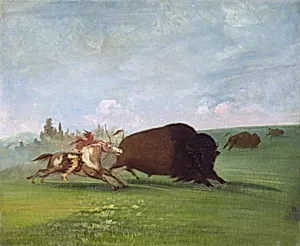
Buffalo Chase, a Single Death
1832-1833
Medium
Painting
Classification
Painting
Department
Smithsonian Collection
Museum
Smithsonian American Art Museum
Credit
Smithsonian American Art Museum, Gift of Mrs. Joseph Harrison, Jr.
Accession Number
1985.66.408
Rights
Public Domain
Tags
About this artwork
“In the chase of the buffalo, or other animal, the Indian generally ‘strips’ himself and his horse, by throwing off his shield and quiver, and every part of his dress, which might be an encumbrance to him in running; grasping his bow in his left hand, with five or six arrows drawn from his quiver, and ready for instant use . . . These horses are so trained, that the Indian has little use for the rein, which hangs on the neck, whilst the horse approaches the animal on the right side, giving his r...
Art Historical Context
George Catlin's *Buffalo Chase, a Single Death* (1832-1833) captures a thrilling moment from Plains Indian life on the Upper Missouri River, where Catlin sketched it during his pioneering travels among Native American tribes. As a 19th-century artist dedicated to documenting Indigenous cultures before Western expansion altered them forever, Catlin portrayed the raw intensity of a buffalo hunt, emphasizing the hunter's skill and harmony with his horse. In Catlin's own vivid words, the Indian rider strips away all encumbrances—shield, quiver, and clothing—to grip his bow and arrows, while his trained pony approaches the massive 2,000-pound bull from the right. At the precise instant of passing, the arrow flies leftward, striking the heart "to the feather." This oil painting highlights the stark size contrast between the hulking buffalo and the nimble pony, showcasing the hunter's precision and the horse's role in the deadly ballet. Rendered in Catlin's realistic style, influenced by his on-site observations, the work preserves a vanishing tradition of buffalo hunting central to Native survival and spirituality. Housed in the Smithsonian American Art Museum, it invites visitors to witness a frozen slice of frontier history.
About the Artist
George Catlin · 1796–1872
George Catlin (1796–1872), born in Wilkes-Barre, Pennsylvania, to Putnam Catlin and Polly Sutton—who had been captured by Native Americans during the 1778 Battle of Wyoming—initially pursued a legal career. Trained at Litchfield Law School, he was admitted to the bar in 1819 but abandoned law after two years to study art in Philadelphia in 1823. Self-taught as a portraitist, Catlin quickly gained ...