
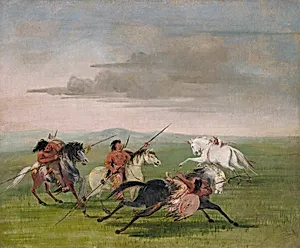
Comanche Feats of Horsemanship
1834-1835
Medium
Painting
Classification
Painting
Department
Smithsonian Collection
Museum
Smithsonian American Art Museum
Credit
Smithsonian American Art Museum, Gift of Mrs. Joseph Harrison, Jr.
Accession Number
1985.66.487
Rights
Public Domain
Tags
About this artwork
“Amongst their feats of riding, there is one that has astonished me more than anything of the kind I have ever seen, or expect to see, in my life:---a stratagem of war, learned and practiced by every young man in the tribe; by which he is able to drop his body upon the side of his horse at the instant he is passing, effectually screened from his enemies’ weapons as he lays in a horizontal position behind the body of his horse, with his heel hanging over the horses' back; by which he has the powe...
Art Historical Context
**Comanche Feats ofemanship** (1834-1835) is a dynamic painting by George Catlin a pioneering 19th-century American artist for his vivid documentation of Native American life. Capturing a thrilling Comanche warrior demonstrating extraordinary equestrian skill, the work showcases the rider dropping low along the horse's side full gallop—shielded from enemies while wielding a bow, shield, or 14-foot lance. Catlin himself marveled at this "stratagem of war," by every young man in the tribe, allowing attacks over the horse's back or under its neck. Painted during Catlin's travels with the United States Dragoons into Indian Territory in 1834, the scene originated as a firsthand sketch amid the vast Plains. Catlin, driven to record Indigenous cultures before Western expansion transformed them, created this as part of his ambitious project to portray over 140 tribes authentically. His realistic style, blending keen observation with dramatic energy, highlights the Comanches' mastery of horses—essential to their warrior identity after acquiring them from Spanish colonizers. Housed in the Smithsonian American Art Museum, this painting offers a window into pre-reservation Comanche prowess, celebrating their agility and bravery in a vanishing world. It's a testament to Catlin's role as both artist and ethnographer, preserving feats that astonished even seasoned observers.
About the Artist
George Catlin · 1796–1872
George Catlin (1796–1872), born in Wilkes-Barre, Pennsylvania, to Putnam Catlin and Polly Sutton—who had been captured by Native Americans during the 1778 Battle of Wyoming—initially pursued a legal career. Trained at Litchfield Law School, he was admitted to the bar in 1819 but abandoned law after two years to study art in Philadelphia in 1823. Self-taught as a portraitist, Catlin quickly gained ...