
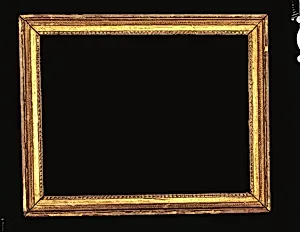
Cassetta frame
Unknown Artist
1770–80
Medium
Softwood
Dimensions
Overall: 19 3/8 × 24 in. (49.2 × 61 cm) Sight: 15 9/16 × 20 3/8 in. (39.5 × 51.8 cm) Rabbet: 16 5/16 × 21 in. (41.5 × 53.4 cm)
Classification
Frames
Culture
Southern France (?)
Department
Robert Lehman Collection
Museum
Metropolitan Museum of Art, New York, NY
Credit
Robert Lehman Collection, 1975
Accession Number
1975.1.2362
Rights
Public Domain
Art Historical Context
Welcome to the Metropolitan Museum of's Robert Lehman Collection, where this elegant **Cassetta frame** from1770–80 stands as a refined example of 18th-century decorative arts. Crafted from soft by an unknown artist, likely from Southern France, measures 19 3/8 × 24 inches overall, with a sight opening of 15 9/16 × 20 3/8 inches. Acquired in 1975, this frame exemplifies the meticulous craftsmanship of the late Rococo or early Neoclassical era, when ornate surrounds were essential to elevating paintings in grand European interiors. The cassetta style, meaning "little box" in Italian, features a flat outer profile with inner moldings that create recessed panels, giving it an architectural depth and sense of containment. Popular from the Renaissance onward, these frames were revived in 18th-century France for their clean lines and versatility, often gilded or painted to harmonize with canvases. Made from softwood—a lightweight, easily carved material—this example highlights regional woodworking techniques, where intricate profiles were achieved through precise joinery and sanding. Though standalone today, such frames were originally designed to frame portraits or landscapes, underscoring how presentation shaped artistic appreciation. A testament to Southern French elegance, it invites us to ponder the unsung role of frames in art history. (198 words)