
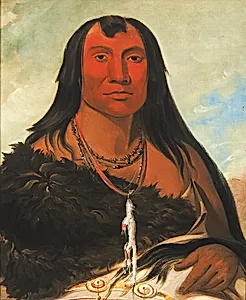
Cháh-ee-chópes, Four Wolves, a Chief in Mourning
1832
Medium
Painting
Classification
Painting
Department
Smithsonian Collection
Museum
Smithsonian American Art Museum
Credit
Smithsonian American Art Museum, Gift of Mrs. Joseph Harrison, Jr.
Accession Number
1985.66.162
Rights
Public Domain
Tags
About this artwork
In 1830, Catlin accompanied William Clark, of the celebrated Lewis and Clark expedition, up the Mississippi River from St. Louis to Fort Crawford. Two years later, he began the first of several journeys deep into the western frontier, boarding the steamboat Yellowstone at St. Louis for a two-thousand-mile run up the Missouri River to Fort Union. The fort, an outpost maintained by the American Fur Company, brought Catlin in contact with the Blackfoot and Crow. Among the masterful portraits he mad...
Art Historical Context
In 1832, pioneering artist George Catlin ventured deep into the American West aboard the steamboat *Yellowstone*, traveling two thousand miles up the Missouri River to Fort Union, an American Fur Company outpost. There, he encountered the Crow and Blackfoot peoples, capturing their likenesses in vivid portraits that preserve a vanishing world. Among these is *Cháh-ee-chópes, Four Wolves, a Chief Mourning*, a poignant bust-length depiction of the Crow leader, his face etched with sorrow. Catlin noted the chief's profound grief for a fallen brother, marked by the ritual sacrifice of locks from his prized long hair—a cultural practice symbolizing deep loss among the Crow. This oil painting exemplifies Catlin's Romantic style, blending ethnographic accuracy with dramatic realism to humanize Native Americans during a time of rapid frontier expansion. As one of his earliest masterpieces from the journey, it highlights the artist's mission to document Indigenous customs before they faded. Today, housed in the Smithsonian American Art Museum, the portrait invites reflection on mourning rituals and resilience, offering visitors a window into 19th-century Native life through Catlin's empathetic gaze.
About the Artist
George Catlin · 1796–1872
George Catlin (1796–1872), born in Wilkes-Barre, Pennsylvania, to Putnam Catlin and Polly Sutton—who had been captured by Native Americans during the 1778 Battle of Wyoming—initially pursued a legal career. Trained at Litchfield Law School, he was admitted to the bar in 1819 but abandoned law after two years to study art in Philadelphia in 1823. Self-taught as a portraitist, Catlin quickly gained ...