
Chinese Portrait Painter
18th century
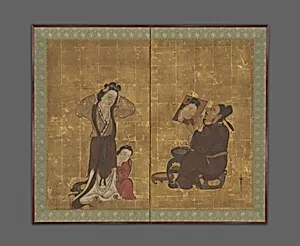
Medium
Two-panel folding screen; ink, color, and gold on paper
Dimensions
40 x 49 1/4 in. (101.6 x 125.1 cm)
Classification
Paintings
Culture & Period
Japan · Edo period (1615–1868)
Department
Asian Art
Museum
Metropolitan Museum of Art, New York, NY
Credit
H. O. Havemeyer Collection, Bequest of Mrs. H. O. Havemeyer, 1929
Accession Number
29.100.528
Rights
Public Domain
Tags
Art Historical Context
**Chinese Portrait Painter** by Miwa Zaiei a captivating two-panel folding screen from Japan's Edo period (1615–8), created in the 18th century Crafted with ink, color, and gold paper (40 x 49¼ in.), this work exemplifies the opulent decorative arts of the time. Folding screens like this were prized household furnishings, often placed in tokonoma alcoves to enhance interiors with their luminous gold backgrounds, which mimicked shimmering light and added depth to scenes. The painting depicts a Chinese portrait painter at work, surrounded by male and female figures—likely artists and assistants—in a bustling studio. Miwa Zaiei, a skilled Edo-era painter, masterfully captures the elegance of daily artistic life, blending Japanese finesse with admiration for Chinese painting traditions. The use of vibrant inks and colors against gold foil highlights meticulous details, from flowing robes to concentrated expressions, reflecting the period's fascination with East Asian cultural exchange. Housed in the Metropolitan Museum of Art's Asian Art department (H. O. Havemeyer Collection, 1929), this screen offers a window into Edo Japan's artistic vibrancy, where screens served as storytelling canvases. It invites visitors to appreciate the harmony of technique and theme in pre-modern Japanese mastery.