
池大雅書 「楓橋夜泊」屏風|"Maple Bridge Night Mooring"
ca. 1770
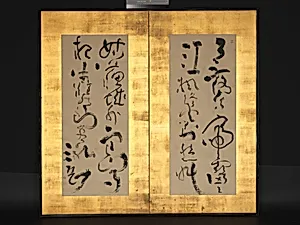
Medium
Two-panel folding screen; ink on paper
Dimensions
Image (each panel): 53 1/4 x 22 1/8 in. (135.3 x 56.2 cm) Overall: 68 3/4 x 72 3/4 in. (174.6 x 184.8 cm)
Classification
Paintings
Culture & Period
Japan · Edo period (1615–1868)
Department
Asian Art
Museum
Metropolitan Museum of Art, New York, NY
Credit
Purchase, Friends of Asian Art Gifts, 2008
Accession Number
2008.66
Rights
Public Domain
Tags
Art Historical Context
Ike Taiga's *Maple Bridge Night Mooring* (ca. 1770) is a masterful two-panel folding screen, in ink on paper, that captures the essence of Japanese literati painting during the Edo period (1615–1868). Taiga (1723–1776), a leading figure in the Nanga ( School) style—inspired by Chinese scholar-artists—blends expressive calligraphy with poetic imagery. The title references the famous Tang dynasty poem "Fengqiao Yebo" by Zhang Ji, evoking moonlit night at Maple Bridge near Suzhou, where the sound of a monk's bellces the autumn chill. Taiga's inscription likely renders this verse in his bold, idiosyncratic script, transforming the screen into a meditative fusion of literature and art. As a byōbu (folding screen), this work exemplifies how Edo-period elites displayed such pieces in tokonoma alcoves, where they served as focal points for contemplation. The modest dimensions (each panel 53¼ × 22⅛ in.) belie its grandeur when opened to 68¾ × 72¾ in., immersing viewers in a serene landscape of longing and transience. Taiga's loose, spontaneous ink techniques—dry brushstrokes and rhythmic lines—reflect Zen influences and personal expression, distinguishing Nanga from more rigid Japanese traditions. Acquired by the Metropolitan Museum of Art in 2008, this screen highlights the cultural bridge between Japan and China, inviting visitors to ponder timeless themes of solitude amid nature's beauty.