
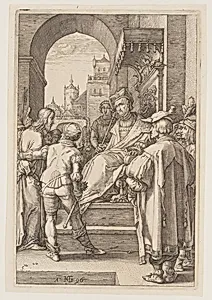
Christ before Pilate, from The Passion
Medium
Engraving on ivory laid paper
Dimensions
Plate: 20.2 × 13.4 cm (8 × 5 5/16 in.); sheet: 21.1 × 14.4 cm (8 5/16 × 5 11/16 in.)
Classification
engraving
Department
Prints and Drawings
Museum
Art Institute of Chicago
Accession Number
268188
Rights
Public Domain
Art Historical Context
In the late 16th century, engraver Hendrick Goltzius created *Christ before Pilate*, one of seven masterful plates from his series *The Passion* (1596). This scene captures the biblical moment from the Gospel of John, where Jesus stands trial before Pontius Pilate amid a tense crowd. Goltzius, a leading figure in Northern Mannerism, drew inspiration from earlier works by Albrecht Dürer and Lucas van Leyden, blending intricate line work with dramatic chiaroscuro to evoke deep emotional intensity. Produced during a time of religious upheaval in the Netherlands, such engravings served as devotional aids, making sacred narratives accessible beyond elite patrons. Goltzius's engraving technique was revolutionary; his virtuoso use of the burin— the sharp tool for incising metal plates—produced swelling lines and velvety textures that mimic oil painting on ivory laid paper, a fine, creamy support prized for its clarity and durability. At just 20.2 × 13.4 cm, the plate's compact scale belies its monumental impact, showcasing crowded figures, expressive gestures, and subtle tonal gradations that heighten the drama of Christ's calm defiance. Housed in the Art Institute of Chicago's Prints and Drawings Department, this work exemplifies the printmaking boom of the Renaissance, democratizing art and influencing generations of artists. Visitors will appreciate its technical brilliance and timeless spiritual resonance.
About the Artist
Hendrick Goltzius · 1558–1617
Hendrick Goltzius (1558–1617) was the most celebrated engraver of the Northern Renaissance and a pivotal figure in Dutch Mannerism. Born near the German-Dutch border, Goltzius transformed printmaking into a virtuoso art form through his revolutionary 'swelling line' technique, where the burin was manipulated to create lines of varying thickness that produced unprecedented tonal effects and three-d...