
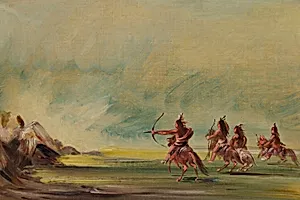
Comanche Giving Arrows to the Medicine Rock
1837-1839
Medium
Painting
Classification
Painting
Department
Smithsonian Collection
Museum
Smithsonian American Art Museum
Credit
Smithsonian American Art Museum, Gift of Mrs. Joseph Harrison, Jr.
Accession Number
1985.66.472
Rights
Public Domain
Tags
About this artwork
“A curious superstition of the Camanchees: going to war, they have no faith in their success, unless they pass a celebrated painted rock, where they appease the spirit of war (who resides there), by riding by it at full gallop, and sacrificing their best arrow by throwing it against the side of the ledge.” (Catlin, 1848 Catalogue, Catlin’s Indian Gallery, SAAM online exhibition)
Art Historical Context
George Catlin painted *Comanche Giving Arrows to the Medicine Rock* between 1837 and 1839 as part of his ambitious Indian, a visual record of Native American tribes he encountered during extensive travels across the Great Plains. The scene captures a Comanche warrior on horseback casting his finest arrow toward a sacred painted rock, a ritual performed at full gallop to seek the favor of the spirit of war before battle. This dramatic moment highlights the deep spiritual traditions that guided Comanche life and warfare in the early nineteenth century. Catlin’s straightforward, documentary approach aimed to preserve the customs, dress, and landscapes of Indigenous peoples he feared were vanishing amid rapid westward expansion. Working in oil on canvas, he emphasized accuracy over embellishment, allowing viewers to glimpse authentic details of Plains equestrian culture and ceremonial practice. The painting now resides in the Smithsonian American Art Museum, a gift that continues to educate audiences about both the richness of Comanche heritage and the artist’s role as an early ethnographer of the American West.
About the Artist
George Catlin · 1796–1872
George Catlin (1796–1872), born in Wilkes-Barre, Pennsylvania, to Putnam Catlin and Polly Sutton—who had been captured by Native Americans during the 1778 Battle of Wyoming—initially pursued a legal career. Trained at Litchfield Law School, he was admitted to the bar in 1819 but abandoned law after two years to study art in Philadelphia in 1823. Self-taught as a portraitist, Catlin quickly gained ...