
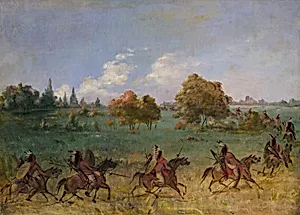
Comanche War Party on the March, Fully Equipped
1846-1848
Medium
Painting
Classification
Painting
Department
Smithsonian Collection
Museum
Smithsonian American Art Museum
Credit
Smithsonian American Art Museum, Gift of Mrs. Joseph Harrison, Jr.
Accession Number
1985.66.596
Rights
Public Domain
Tags
About this artwork
George Catlin’s descriptions of Native Americans reveal his respect for the tribes and nations that he feared would soon vanish. “Every one of these red sons of the forest (or rather of the prairie) is a knight and lord,” he wrote, the only things which he deems worthy of his exertions are to mount his snorting steed, with his bow and quiver slung, his arrow-shield upon his arm, and his long lance glistening in the war-parade . . .” (Catlin, Letters and Notes, vol. 1, no. 4, 1841, reprint 1973; ...
Art Historical Context
George Catlin’s “anche War Party on the, Fully Equipped captures a group of Comanche warriors riding across the plains, equipped with bows, quivers, shields, and lances. Painted between 1846 and 1848, the work reflects Catlin’s deep respect for the Native peoples he encountered during his travels in the 1830s. He portrayed them not as stereotypes but as skilled horsemen and proud defenders of their way of life, describing each warrior as “a knight and lord” whose greatest pride lay in riding his horse into the field. Catlin created hundreds of paintings and sketches to document tribes he feared would soon disappear under the pressures of westward expansion. This particular scene highlights the Comanche’s renowned equestrian culture and military traditions at a moment when their dominance on the southern plains was already facing dramatic change. The painting serves as both an artistic record and a historical document, preserving details of dress, weaponry, and movement for future generations. Today the work resides in the Smithsonian American Art Museum, where it continues to offer viewers an intimate glimpse into a vanished era of Native American life on the frontier.
About the Artist
George Catlin · 1796–1872
George Catlin (1796–1872), born in Wilkes-Barre, Pennsylvania, to Putnam Catlin and Polly Sutton—who had been captured by Native Americans during the 1778 Battle of Wyoming—initially pursued a legal career. Trained at Litchfield Law School, he was admitted to the bar in 1819 but abandoned law after two years to study art in Philadelphia in 1823. Self-taught as a portraitist, Catlin quickly gained ...