
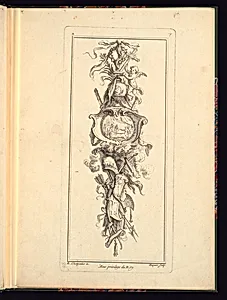
Design for a Pendant Trophy
Classification
Department
Smithsonian Collection
Museum
Smithsonian American Art Museum
Credit
Purchased for the Museum by the Advisory Council
Accession Number
1921-6-519-5
Rights
Public Domain
About this artwork
Research in Progress
Art Historical Context
This print, titled *Design for a Pendant Trophy is by the French artist René Charpentier (0–1723) and dates to around 1736. Though Charpentier died more than a decade earlier, the later date indicates this is likely a posthumous reproducing one of his ornamental designs. Classified as a print (medium unknown), it would have circulated among goldsmiths, jewelers, and decorative artists as a practical model. A “pendant trophy” is a hanging ornamental composition—typically an elegant cluster of weapons, musical instruments, foliage, or victory symbols—meant to be executed in metal, enamel, or carved wood. Such motifs were hallmarks of late-Baroque and emerging Rococo taste in early-eighteenth-century France, where they adorned jewelry, furniture mounts, and architectural interiors. Charpentier’s refined line work, even in reproduction, captures the period’s love of graceful asymmetry and luxurious detail. Acquired for the Smithsonian American Art Museum by the Advisory Council, the sheet offers a glimpse into how French design ideas traveled and were adapted across Europe. While research on this particular impression remains in progress, it stands as a quiet testament to the collaborative world of printmakers and craftsmen who translated an artist’s invention into objects of everyday elegance.