
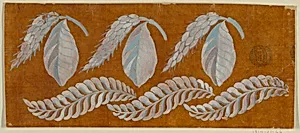
Design for an Embroidered or Woven Horizontal Border, of the "Fabrique de Sts. Ruf," Unfinished
1805–1815
Classification
Drawing
Department
Smithsonian Collection
Museum
Smithsonian American Art Museum
Credit
Gift of Eleanor and Sarah Hewitt
Accession Number
1914-21-66
Rights
Public Domain
About this artwork
Research in Progress
Art Historical Context
This unfinished drawing, titled *Design for an Embroidered oroven Horizontal Border* from the Fabrique de Ruf in Lyon, France (ca. 1805–1815), offers a glimpse into the golden age of Lyon's textile industry. Lyon was Europe's premier hub for silk weaving during the Napoleonic era, producing luxurious fabrics for fashion, furnishings, and export. The Fabrique de Saint Ruf a prominent manufactory, specialized in intricate designs that powered this economic powerhouse, blending artistry with industrial. As a preparatory drawing—its medium yet to be fully identified—this work served as a blueprint for embroidered or woven borders, likely intended for shawls, ribbons, or upholstery. Such designs were meticulously drafted by artisans to guide Jacquard looms or needleworkers, showcasing the era's shift toward repeatable, complex patterns that democratized opulence. The horizontal border motif hints at repetitive floral or geometric elements typical of Empire-style textiles, reflecting neoclassical influences. Housed in the Smithsonian American Art Museum through the generous gift of Eleanor and Sarah Hewitt, this piece awaits further research, inviting us to ponder the anonymous hands behind France's textile legacy. It reminds visitors of how drawings like this bridged creativity and commerce, shaping global tastes in the early 19th century.