
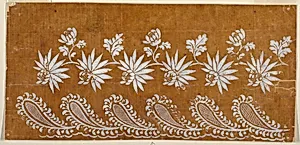
Design for an Embroidered or Woven Border
Classification
textile designs
Department
Smithsonian Collection
Museum
Smithsonian American Art Museum
Credit
Gift of Eleanor and Sarah Hewitt
Accession Number
1914-21-124
Rights
Public Domain
About this artwork
Research in Progress
Art Historical Context
Housed in the Smithsonian American Art Museum *Design for an Embro or Woven Border* from the Fabrique de Saint Ruf, renowned textile workshop in Lyon, France dating to 1805–15. Lyon was Europe's silk capital during this era, a hub of innovation where factories like Saint Ruf produced exquisite patterns for luxury fabrics destined for elite wardrobes, furnishings, and exports. This design, gifted by Eleanor and Sarah Hewitt, exemplifies meticulous preparatory sketches that bridged artistry and industry. Created amid Napoleon's Empire period, the work reflects a time when French textiles symbolized national prestige and neoclassical elegance. Designers crafted borders—repeating motifs for edges of shawls, dresses, or upholstery—to showcase technical prowess in weaving or embroidery. Though details of its medium remain under research, such patterns were typically rendered in ink, watercolor, or gouache, allowing weavers to translate intricate details into shimmering silks. This piece highlights the collaborative genius of Lyon's silk trade, blending fine art with commerce. It invites us to appreciate the unseen labor behind opulent 19th-century fashion, a testament to how textile designs fueled France's cultural and economic dominance. (198 words)