
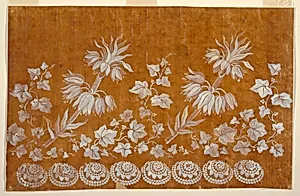
Design for an Embroidered or Woven Horizontal Border of the "Fabrique de St. Ruf"
1805–1815
Medium
Drawing
Classification
Drawing
Department
Smithsonian Collection
Museum
Smithsonian American Art Museum
Credit
Gift of Eleanor and Sarah Hewitt
Accession Number
1914-21-98
Rights
Public Domain
About this artwork
Research in Progress
Art Historical Context
This delicate drawing, titledDesign for an Embro or Woven Horizontal Border the "Fabrique de. Ruf"*, hails from the renowned textile hub of Lyon, France, created by the Fabrique de Saint Ruf workshop between 1805 and1815. As a preparatory sketch in ink or pencil on paper, it served as a blueprint for producing luxurious embroidered or woven borders—repeating motifs ideal for enhancing fabrics like shawls upholstery, or garments. Such designs were essential in Lyon's silk industry, which flourished during the Napoleonic era, blending artistry with emerging industrial techniques to meet demand across Europe and beyond. Lyon's status as the "silk capital" of the world underscores the drawing's historical significance. Workshops like Fabrique de Saint Ruf employed skilled designers to innovate patterns, often drawing from neoclassical or Empire styles popular at the time, though specifics of this border's motifs await further research. These designs fueled France's textile exports, influencing global fashion and interiors. Now part of the Smithsonian American Art Museum's collection—thanks to the generous gift of collectors Eleanor and Sarah Hewitt—this piece offers a window into the creative process behind opulent 19th-century textiles. It reminds us how humble drawings sparked grandeur in everyday luxury. (198 words)