
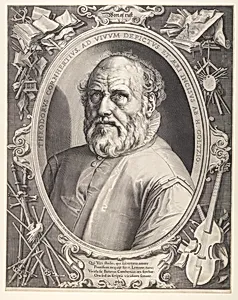
Dirck Volkertsz. Coornhert (with frame)
Medium
Engraving on ivory laid paper
Dimensions
Sheet: 52.4 × 41.4 cm (20 11/16 × 16 5/16 in.)
Classification
engraving
Department
Prints and Drawings
Museum
Art Institute of Chicago
Accession Number
268780
Rights
Public Domain
Art Historical Context
In the Prints and Drawings department of the Institute of Chicago, Hendrickoltzius's *Dirck Volkertsz. Coornhert (with)* (1591) stands as masterful engraving on ivory laid paper, measuring impressive 52.4 41.4 cm. Goltzius, a leading Dutch Mannerist printmaker of the late 16th, captures the likeness of Dirck Volkertsz. Coornhert, a humanist scholar, philosopher, theologian, engraver himself. Created during the Dutch Golden Age's early stirrings amid the Eighty Years' War, this portrait honors Coornhert's advocacy for religious tolerance and intellectual freedom, reflecting the era's ferment of Renaissance ideas in the Northern Netherlands. Goltzius's technical brilliance shines through his innovative engraving techniques, particularly his signature "swelling line"—a fluid, varying stroke that mimics the brushwork of painting, creating remarkable depth, texture, and three-dimensionality on the smooth ivory laid paper. This high-quality medium enhanced the print's luminosity and detail, making it a prized reproductive art form that disseminated portraits across Europe. Far from mere replication, Goltzius elevates Coornhert's dignified gaze and fur-collared attire into a celebration of humanist ideals. This work exemplifies how engravings bridged art and ideas, allowing Goltzius's virtuosity to immortalize influential figures like Coornhert for generations of scholars and collectors.
About the Artist
Hendrick Goltzius · 1558–1617
Hendrick Goltzius (1558–1617) was the most celebrated engraver of the Northern Renaissance and a pivotal figure in Dutch Mannerism. Born near the German-Dutch border, Goltzius transformed printmaking into a virtuoso art form through his revolutionary 'swelling line' technique, where the burin was manipulated to create lines of varying thickness that produced unprecedented tonal effects and three-d...