
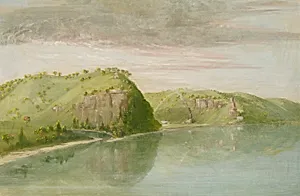
Dubuque's Grave, Upper Mississippi
1835-1836
Medium
Painting
Classification
Painting
Department
Smithsonian Collection
Museum
Smithsonian American Art Museum
Credit
Smithsonian American Art Museum, Gift of Mrs. Joseph Harrison, Jr.
Accession Number
1985.66.330
Rights
Public Domain
Tags
About this artwork
“Dubuque's Grave is a place of great notoriety on this river, in consequence of its having been the residence and mining place of the first lead mining pioneer of these regions, by the name of Dubuque, who held his title under a grant from the Mexican Government (I think), and settled by the side of this huge bluff, on the pinnacle of which he erected the tomb to receive his own body, and placed over it a cross with his own inscription on it . . . At the foot of this bluff, there is now an exten...
Art Historical Context
George Catlin's *Dubuque's Grave, Upper Mississippi* (183–1836) captures a poignant landmark on the Upper Mississippi River the artist's ambitious expedition to document America's frontier. A pioneering painter of Native American life and Western landscapes, Cat traveled the river in the mid-1830s, sketching and painting scenes that preserved a rapidly changing wilderness. This oil painting reflects his realist style, blending keen observation with a romantic sense of exploration, as he chronicled sites of historical intrigue amid the vast, untamed American heartland. The artwork centers on the grave of Julien Dubuque, the first lead-mining pioneer in the region, who reportedly held a land grant—Catlin notes from the Mexican government—and settled at the base of a towering bluff. Atop this bluff, Dubuque built his own tomb, marked by a cross bearing his inscription, symbolizing early European incursion into Native territories. By Catlin's time, the site bustled with industry: a massive smelting furnace at the foot processed lead ore dug from surrounding hills, foreshadowing Iowa's mining boom and the clash of nature and commerce. Housed in the Smithsonian American Art Museum, this piece highlights Catlin's role in ethnographic art, offering visitors a window into 19th-century expansion and the enduring mystique of the Mississippi. (198 words)
About the Artist
George Catlin · 1796–1872
George Catlin (1796–1872), born in Wilkes-Barre, Pennsylvania, to Putnam Catlin and Polly Sutton—who had been captured by Native Americans during the 1778 Battle of Wyoming—initially pursued a legal career. Trained at Litchfield Law School, he was admitted to the bar in 1819 but abandoned law after two years to study art in Philadelphia in 1823. Self-taught as a portraitist, Catlin quickly gained ...