
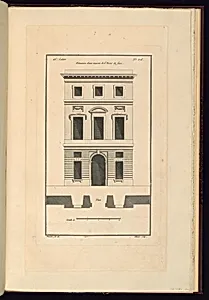
Elevation d'une maison de 6 toises de face
Classification
Department
Smithsonian Collection
Museum
Smithsonian American Art Museum
Credit
Purchased for the Museum by the Advisory Council
Accession Number
1921-6-254-80
Rights
Public Domain
About this artwork
Research in Progress
Art Historical Context
Juste-François Boucher (6–1782), son of the renowned Rococo master François Boucher, created *Elevation d'une maison de 6 toises de face* around 1775. As a skilled French engraver, Boucher specialized in prints that captured the elegance of 18th-century design, blending his father's ornamental flair with emerging Neoclassical precision. This work, now in the Smithsonian American Art Museum's collection (purchased by the Advisory Council), exemplifies the period's fascination with architectural documentation. The title refers to the front elevation of a house measuring six toises (an old French unit roughly 12 feet wide), presenting a detailed rendering of a townhouse facade. Such prints were vital tools for architects, builders, and patrons, disseminating fashionable designs across Europe amid the Enlightenment's emphasis on symmetry and proportion. Though the exact medium remains under study, its classification as a print highlights engraving's role in preserving and sharing architectural ideas with remarkable clarity and reproducibility. Held in the Smithsonian Collection, this piece bridges French decorative arts and American interests in European influences during the early republic. It invites visitors to imagine the bustling workshops of pre-Revolutionary Paris, where such elevations shaped urban landscapes and inspired transatlantic architecture. Research continues to uncover more about its creation and impact.