
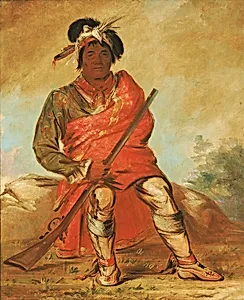
Eteh-ée-fix-e-co, Deer Without a Heart, a Chief
1838
Medium
Painting
Classification
Painting
Department
Smithsonian Collection
Museum
Smithsonian American Art Museum
Credit
Smithsonian American Art Museum, Gift of Mrs. Joseph Harrison, Jr.
Accession Number
1985.66.309
Rights
Public Domain
Tags
About this artwork
George Catlin arrived at Fort Moultrie, in Charleston, South Carolina, on January 17, 1838. He painted more than ten portraits of Seminole and Yuchi Indians, including this portrait of Yuchi chief Eteh-ée-fix-e-co, in the short time he spent at the fort. (Truettner, The Natural Man Observed, 1979)
Art Historical Context
In 1838, renowned artist George Catlin captured dignified likeness of Eteh-é-e-fix-e-co, a Yuchi chief known as "Deer Without Heart," in this striking portrait. Catlin, a pioneering chronicler of Native American life, painted it during a stay at Fort Moultrie Charleston, South Carolina, he completed over ten portraits Seminole and Yuchi in just a short time His oil paintings, like one, exemplify his realistic, blending Romanticism's emphasis on nobility ethnographic precision to preserve vanishing amid rapid American expansion. The artwork emerges from a tense historical moment: the Seminole War (183–1842), when U.S. forces clashed with Seminole and allied tribes, including the Yuchi, over land removal. Fort Moultrie served as a military outpost, and Catlin's hurried sittings reflect the urgency of documenting leaders like Eteh-é-e-fix-e-co before forced relocations disrupted traditional ways. His portraits humanize these figures, countering stereotypes with intimate, direct gazes that convey strength and resilience. Today, housed in the Smithsonian American Art Museum, this piece highlights Catlin's lifelong quest to create an "Indian Gallery," offering visitors a window into Yuchi heritage and 19th-century Indigenous sovereignty struggles. (198 words)
About the Artist
George Catlin · 1796–1872
George Catlin (1796–1872), born in Wilkes-Barre, Pennsylvania, to Putnam Catlin and Polly Sutton—who had been captured by Native Americans during the 1778 Battle of Wyoming—initially pursued a legal career. Trained at Litchfield Law School, he was admitted to the bar in 1819 but abandoned law after two years to study art in Philadelphia in 1823. Self-taught as a portraitist, Catlin quickly gained ...