
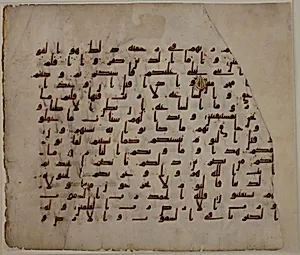
Folio from a Qur'an Manuscript
Unknown Artist
late 8th–early 9th century
Medium
Ink, opaque watercolor, and gold on parchment
Dimensions
H. 11 1/8 in. (28.3 cm) W. 9 1/2 in. (24.1 cm)
Classification
Codices
Department
Islamic Art
Museum
Metropolitan Museum of Art, New York, NY
Credit
Gift of Adrienne Minassian, in memory of Dr. Richard Ettinghausen, 1979
Accession Number
1979.201
Rights
Public Domain
Art Historical Context
This exquisite folio from a Qur'an manuscript, dating to the late 8th or early 9th century offers a glimpse into the dawn of Islamic artistic traditions. Crafted during the Abbasid era, when Baghdad emerged as a center of learning and culture, it represents one of the earliest surviving examples of the sacred text in codex form—a bound book format that revolutionized manuscript production, making the Qur'an more portable and accessible than scrolls. Rendered in ink, opaque watercolor, gold on parchment, the folio showcases masterful calligraphy, likely in the angular Kufic script typical of the period. The use of shimmering gold for diacritical marks and verse markers elevated the page's spiritual luminosity, while vibrant watercolors added subtle geometric embellishments. Parchment, dyed reddish-brown for durability, was the premium medium before paper's widespread adoption, underscoring the reverence for this holy scripture. Housed in the Metropolitan Museum of Art's Islamic Art Department, this 11 1/8 x 9 1/2-inch leaf (gift of Adrienne Minassian in memory of Dr. Richard Ettinghausen, 1979) highlights calligraphy as the pinnacle of Islamic art. In a faith prohibiting idolatry, these intricate letters became vessels of divine beauty, blending devotion, precision, and innovation for worshippers across centuries.