
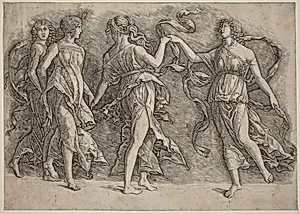
Four Dancing Muses
after 1497
Medium
engraving on laid paper
Dimensions
sheet: 23.9 x 33.6 cm (9 7/16 x 13 1/4 in.)
Classification
Department
CG-E
Museum
National Gallery of Art, Washington, D.C.
Credit
Gift of W.G. Russell Allen
Accession Number
1941.1.10
Rights
Public Domain
Art Historical Context
Created in the workshop of Andrea Mantegna after 1497, *Four Dancing Muses* captures the graceful movement of mythological figures in a delicate engraving on laid paper. Mantegna, a leading figure of the Italian Renaissance, was renowned for his fascination with classical antiquity, and his workshop continued this tradition through reproductive prints that made such imagery widely accessible. Measuring roughly 24 by 34 centimeters, this work exemplifies the period’s growing interest in disseminating artistic ideas beyond the walls of palaces and churches. Engraving as a medium held particular significance during the Renaissance, allowing artists to achieve fine lines and intricate details that could be printed repeatedly. This technique helped spread humanist ideals and classical themes across Europe, influencing generations of artists and collectors. The depiction of dancing Muses—goddesses of inspiration in Greek and Roman mythology—reflects the era’s revival of ancient stories, blending scholarly interest with visual delight. Housed in the National Gallery of Art as a gift from W.G. Russell Allen, the print offers modern viewers a window into how Renaissance workshops balanced artistic innovation with the practical demands of reproduction. Its lively composition invites contemplation of movement, harmony, and the enduring appeal of mythological subjects.