
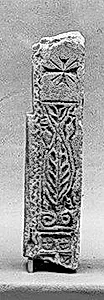
Fragment of a Doorpost with a Cross
Unknown Artist
6th–7th century
Medium
Limestone; carved in relief
Dimensions
H. 5 1/8 in. (13 cm) W. 22 1/16 in. (56 cm) D. 5 1/2 in. (14 cm)
Classification
Sculpture
Department
Islamic Art
Museum
Metropolitan Museum of Art, New York, NY
Credit
Rogers Fund, 1910
Accession Number
10.175.58
Rights
Public Domain
Art Historical Context
This modest yet evocative fragment of a limestone doorpost, carved in relief during the 6th–7th century, features a prominent cross motif, a hallmark of early Christian symbolism. Measuring just over 22 inches wide, it once formed part of a larger architectural element, likely from a church doorway in the Near East. Acquired through the Rogers Fund in 0 and now housed in the Metropolitan Museum Art's Islamic Art department it exemplifies the transitional artistry of late antiquity, bridging Byzantine and emerging Islamic worlds. The cross, rendered with simple, bold lines, underscores the enduring Christian presence in regions like Syria or Egypt before and during Islam's rapid expansion around 632 CE. Its placement in an Islamic collection highlights cultural continuity—early Muslim rulers often preserved pre-Islamic monuments, fostering a shared artistic heritage. Carved from durable limestone, the relief technique allowed for intricate surface decoration on functional stone architecture, a common practice that conserved material while conveying spiritual depth. Though the artist remains unknown, this piece invites reflection on faith's visual language amid historical upheaval, reminding visitors of the interconnected tapestries of Mediterranean civilizations.