
Frontispiece to Les baisers morts
1893
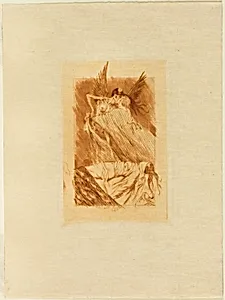
Medium
Soft varnish ("vernis mou") etching, drypoint and roulette in brownish-red on cream wove paper
Dimensions
Image: 10.4 × 6.6 cm (4 1/8 × 2 5/8 in.); Plate: 10.8 × 7.1 cm (4 5/16 × 2 13/16 in.); Sheet: 18.7 × 14 cm (7 3/8 × 5 9/16 in.)
Classification
etching
Department
Prints and Drawings
Museum
Art Institute of Chicago
Accession Number
131998
Rights
Public Domain
Art Historical Context
Félicien Rops, a Belgian artist renowned for his provocative fin-de-siècle etchings, created this *Frontispiece Les baisers morts in 1893. As a key figure in Symbolism andadence, Rops often blendedism with macabre themes, capturing the undercurrents of late th-century European culture. intimate print served as the title illustration for a poetic work evoking "dead," reflecting the era's fascination with mortality,, and the occult amid Belle Époque excess. ed in soft-ground etchingvernis mou), dry, and roulette on cream wove paper, work showcases Rops's mastery ofaglio techniques. Soft-ground allowed textured impressions, dry produced rich, velv lines, and roulette added tonal gradations in brownish-red ink—creating a haunting, atmospheric depth on its tiny scale (image just 10.4 × 6.6 cm). These methods highlight printmaking's democratic potential, enabling intricate details reproducible for elite collectors. Housed in the Art Institute of Chicago's Prints and Drawings Department, this etching exemplifies Rops's enduring influence on modern graphic arts, bridging illustration and fine art while challenging Victorian sensibilities with its sensual morbidity. A captivating glimpse into Symbolist intrigue!
About the Artist
Félicien Rops · 1833–1898
Félicien Rops, born Félicien Victor Joseph Rops on July 7, 1833, in Namur, Belgium, to a prosperous textile manufacturing family, displayed prodigious artistic talent from youth. The only child of Nicholas Rops and Sophie Maubile, he received private tutoring until age ten, followed by education at a Jesuit school in Namur (1843–1848), the Athénée Royal de Namur, and the Academy of Fine Arts there...