
Green Corn Dance, Hidatsa
1835-1837
Medium
Painting
Classification
Painting
Department
Smithsonian Collection
Museum
Smithsonian American Art Museum
Credit
Smithsonian American Art Museum, Gift of Mrs. Joseph Harrison, Jr.
Accession Number
1985.66.446
Rights
Public Domain
Tags
About this artwork
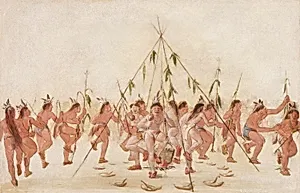
“On the day appointed by the doctors, the villagers are all assembled, and in the midst of the group a kettle is hung over a fire and filled with the green corn, which is well boiled, to be given to the Great Spirit, as a sacrifice necessary to be made before any one can indulge the cravings of his appetite. Whilst this first kettleful is boiling, four medicine-men, with a stalk of the corn in one hand and a rattle (she-she-quoi) in the other, with their bodies painted with white clay, dance aro...
Art Historical Context
George Catlin's *Green Corn Dance, Hida* (1835–1837) captures a vibrant ritual of the Hidatsa people, a Native American tribe from the Northern Plains, during his extensive travels among Indigenous communities in the 183s. As a pioneering and ethnographer, Catlin documented 600 portraits and scenes of tribal life, aiming to preserve cultures he feared were vanishing due to westward expansion. This oil painting, now in the Smithsonian American Art Museum, exemplifies his realistic style, blending keen observation with Romantic admiration for Native traditions. The scene depicts a sacred thanksgiving ceremony where green corn is boiled in a kettle as an offering to the Great Spirit before anyone eats. Four medicine-men, painted with white clay and holding corn stalks and rattles, dance around the fire while chanting. Warriors form a wider circle, joining the song, as villagers watch and wooden bowls with horn spoons await the feast. This ritual underscores the Hidatsa's deep agricultural ties and spiritual reverence for the land's bounty. Catlin's firsthand account highlights the ceremony's communal joy and reverence, making the painting a vital ethnographic record of pre-reservation Hidatsa life. It invites viewers to appreciate the harmony between people, nature, and spirituality in Indigenous Western cultures.
About the Artist
George Catlin · 1796–1872
George Catlin (1796–1872), born in Wilkes-Barre, Pennsylvania, to Putnam Catlin and Polly Sutton—who had been captured by Native Americans during the 1778 Battle of Wyoming—initially pursued a legal career. Trained at Litchfield Law School, he was admitted to the bar in 1819 but abandoned law after two years to study art in Philadelphia in 1823. Self-taught as a portraitist, Catlin quickly gained ...