
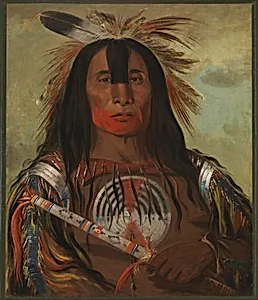
Stu-mick-o-súcks, Buffalo Bull's Back Fat, Head Chief, Blood Tribe
1832
Medium
Painting
Classification
Painting
Department
Smithsonian Collection
Museum
Smithsonian American Art Museum
Credit
Smithsonian American Art Museum, Gift of Mrs. Joseph Harrison, Jr.
Accession Number
1985.66.149
Rights
Public Domain
Tags
About this artwork
George Catlin's Indian Gallery is an unparalleled collection of great artistic and historic significance that contributes to understanding America's frontier and the cultures of the Native Americans who lived there. George Catlin (1796-1872) was the first major artist to travel beyond the Mississippi to record what he called the "manner and customs" of American Indians, painting scenes and portraits from life. He wanted to document these native cultures before they were irrevocably altered by se...
Art Historical Context
**Stu-mick-o-súcks, Buffalo Bull's Fat, Head Chief, Tribe** (1832) by Georgelin captures the dignified likeness of a prominent Blackfoot leader from the Blood Tribe. Painted during Catlin's pioneering expeditions across the Great Plains between 1830 and 1836, this oil portrait part of his monumental Indian Gallery—over works documenting more than 50 Native American tribes. As the first major artist to venture beyond the Mississippi, Cat sketched and painted from life, driven by a urgent mission to preserve the "manners and customs" of Indigenous peoples before the devastating impacts of frontier settlement and the Indian Removal Act of 1830. This bust-length portrait highlights Stu-mick-o-súcks in traditional Indian dress, holding a smoking material that reflects daily cultural practices. Catlin's realistic style, rooted in Romanticism and ethnographic observation, renders the chief's stern gaze and ornate regalia with vivid detail, emphasizing personal presence over idealization. Such works offered 19th-century audiences rare, authentic glimpses into Plains Indian life. Today, housed in the Smithsonian American Art Museum, this painting endures as a vital historical record, bridging art and anthropology while honoring the resilience of Native cultures amid profound change. (198 words)
About the Artist
George Catlin · 1796–1872
George Catlin (1796–1872), born in Wilkes-Barre, Pennsylvania, to Putnam Catlin and Polly Sutton—who had been captured by Native Americans during the 1778 Battle of Wyoming—initially pursued a legal career. Trained at Litchfield Law School, he was admitted to the bar in 1819 but abandoned law after two years to study art in Philadelphia in 1823. Self-taught as a portraitist, Catlin quickly gained ...